Category: Technology

Technology news and analysis covering products, platforms, digital change, AI and the business of innovation.

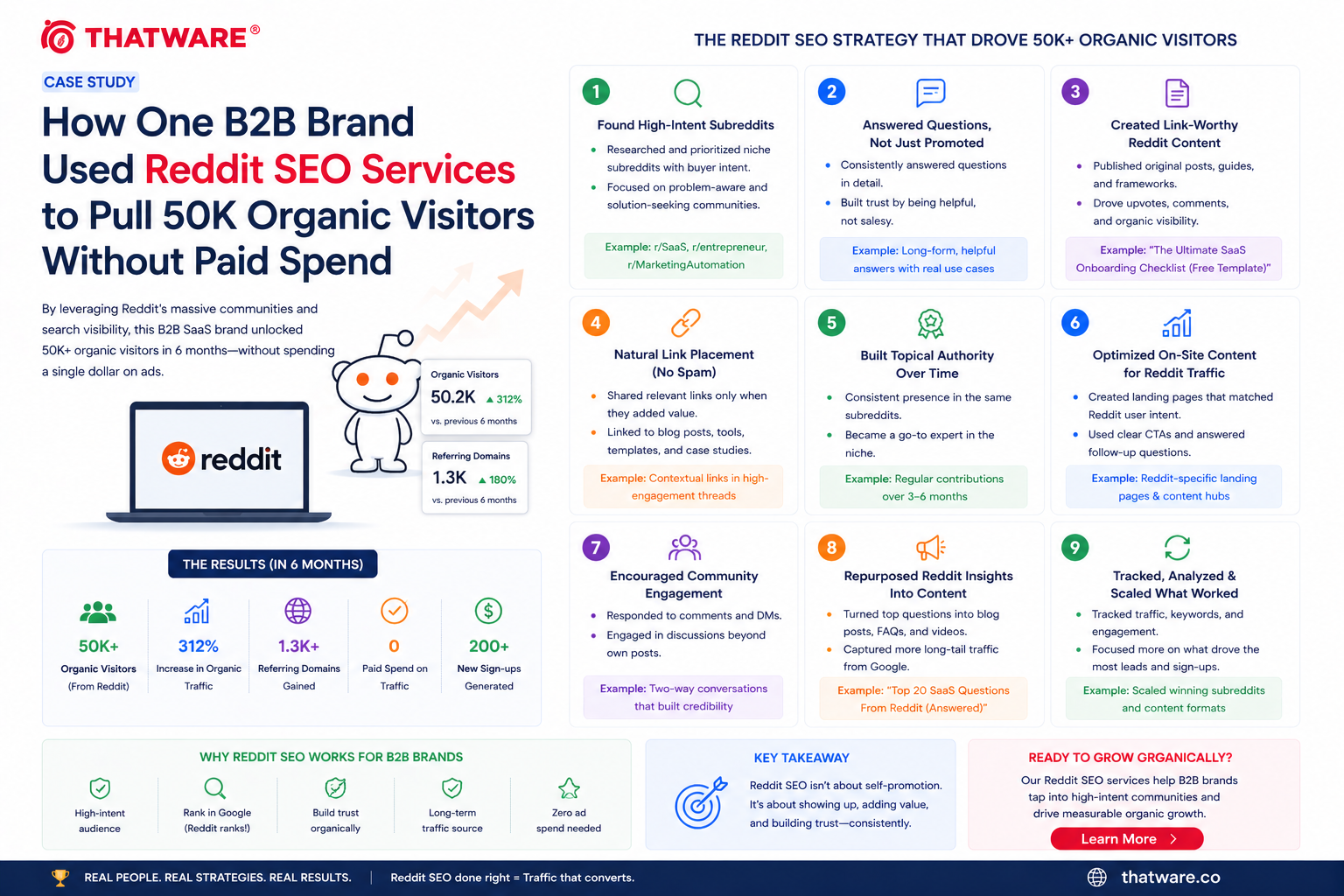
  • How One B2B Brand Used Reddit SEO Services to Pull 50K Organic Visitors Without Paid Spend

    How One B2B Brand Used Reddit SEO Services to Pull 50K Organic Visitors Without Paid Spend

    The story behind this particular case involves a B2B software company in the project management space — a market that’s both competitive and saturated with content from players with significantly larger marketing budgets. The company had been publishing content for eighteen months with modest organic results, running a conventional blog strategy that was producing traffic but not at the pace the business needed.

    The pivot to a Reddit-centred content and community strategy wasn’t planned as a grand move. It started with the founder spending time in communities where their target buyers — team leads, operations managers, small business owners — were already hanging out and asking questions that the product was built to solve.

    What follows is an honest account of what worked, what didn’t, and what the 50,000 monthly visitor number actually represented.


    The Starting Point: Listening Before Talking

    The first three months of the Reddit strategy were almost entirely passive. The marketing lead joined twelve subreddits relevant to their target audience — r/projectmanagement, r/smallbusiness, r/entrepreneur, r/sysadmin (relevant because their tool had IT team applications), and several vertical communities specific to their industry focus areas.

    The explicit instruction during this phase was: contribute, don’t promote. Answer questions helpfully. Engage in discussions about problems the product solved without mentioning the product. Build a genuine account history with a real participation pattern.

    This sounds patient to the point of being commercially irresponsible. In practice, it was one of the highest-leverage investments the team made. By month three, they had:

    A genuine understanding of how their target buyers described their problems in their own language — not the language the marketing team used internally, but the actual vocabulary of frustrated operations managers at 11pm trying to explain to peers why their team coordination kept failing.

    An account with enough history and contribution that future product mentions wouldn’t read as spam.

    Relationships — informal, online, but genuine — with several community members who turned out to be useful amplifiers later.


    The Content That Attracted the Links

    The SEO dimension of the strategy came from the second phase: creating content specifically designed to answer the questions that were appearing repeatedly in the subreddits they’d been monitoring.

    Not content designed to rank for obvious keywords. Content designed to be genuinely useful to the exact community members asking the exact questions they’d been observing. The framing was always: “what would be the most useful resource I could share with someone who just asked this question?”

    This produced a set of content pieces that were structurally different from their previous blog content:

    Longer and more specific than typical blog posts. The questions in these communities were detailed — “how do we handle project handoffs when the client-facing team and the internal delivery team work in completely different tools” — and the useful answers were detailed too.

    Written in the vocabulary of practitioners, not marketers. The posts read like they were written by someone who had experienced the problems they were describing, because they were.

    Explicitly structured to be easily shared in community discussions. The format and length worked for someone dropping a link in a comment as a “this is the most useful thing I’ve found on this” resource.

    When these pieces were shared in relevant communities — by the company account, transparently, in response to genuinely relevant discussions — the organic community sharing that followed was significantly higher than anything their previous content had generated.


    How Reddit Traffic Became Search Traffic

    The reddit seo services mechanism that made this a search traffic story rather than just a Reddit traffic story is worth explaining specifically.

    Reddit threads rank in Google. Well-engaged threads on large subreddits appear in Google search results for the queries they discuss, often on the first page. When those threads contain links to your content, and when your content appears in Google’s own results alongside the thread, the reinforcing effect on organic visibility is real.

    Additionally, the engagement signals from genuine community sharing — click-through rate, time on page, low bounce rate, return visits — create positive behavioural signals that influence how Google evaluates the content’s quality over time.

    The 50,000 monthly visitor number that the brand achieved by month twelve came approximately equally from three sources: direct Reddit traffic (people clicking links in threads), Google search traffic for queries where the content ranked directly, and Google search traffic for queries where Reddit threads referencing the content appeared and drove searchers to the brand’s site as a result.


    The Product Mention Protocol

    The question of how and when to mention the product in Reddit communities is worth addressing specifically, because it’s where most brand Reddit strategies go wrong.

    The protocol the brand used: product mentions only in response to specific direct questions about solutions, always transparently disclosed (“I work at X, we built something specifically for this”), and never in the context of discussions where the product wasn’t genuinely directly relevant.

    The explicit ban on: initiating discussions about the product category without a specific community question that motivated it, commenting on competitor discussions to insert product comparisons, and using multiple accounts for amplification.

    This approach kept the account in good standing across all twelve communities throughout the programme. They were never banned, never called out for spam, and in several communities became known as a genuine contributor — which produced the kind of organic mention by other community members that money can’t buy.

    Rank on reddit google results for their target queries was a direct outcome of this community reputation. Posts that referenced their content organically were among the highest-engaged in relevant subreddits, and those posts ranked in Google for the long-tail queries they addressed.


    What the 50K Visitors Actually Meant Commercially

    Let’s be honest about the commercial translation, because traffic without conversion context is incomplete.

    Of the 50,000 monthly visitors at the twelve-month mark, approximately 35% were engaged enough with the content to consume more than one piece. The email list grew by around 800 subscribers per month from this traffic, at a conversion rate of roughly 1.6%. Trial sign-ups from this organic channel ran at about 0.4% of total visitors — around 200 per month.

    At the company’s trial-to-paid conversion rate, that represented a meaningful and measurable revenue contribution. The cost per trial sign-up from this channel was a fraction of their paid search cost per equivalent conversion, and the quality of leads was higher — people who had already demonstrated genuine engagement with content that accurately described the problem their product solved.

    The 50,000 headline number is real. The commercial impact per visitor is lower than from branded or high-intent search traffic. But the economics were positive and improving as the community relationships continued to compound.


    What Doesn’t Transfer

    A few honest notes on what this approach doesn’t generalise to:

    It requires a product that solves a problem people genuinely discuss in communities. If your buyers don’t hang out in accessible Reddit communities, the channel isn’t available to you.

    It requires patience and resource allocation for a channel that doesn’t produce immediate results. The first three months of purely passive investment are genuinely required, and most marketing teams under quarterly pressure can’t sustain this.

    It requires authentic community expertise — someone who can engage genuinely in these communities is different from someone executing a content distribution brief. The difference is obvious to community members.

    For the companies and markets where these conditions apply, the combination of reddit seo services and organic community strategy can produce exactly what this case represents: significant, compounding, paid-independent organic visibility in communities where actual buyers congregate.




  • E-Bike Motor: Innovate and Explore with a Drone Motor Kit

    E-Bike Motor: Innovate and Explore with a Drone Motor Kit

    In the modern era of technology and mobility, hands-on projects are a great way to understand electronics, mechanics, and automation. An ebike motor is a core component of electric bicycles, providing smooth propulsion and energy-efficient transportation. Similarly, a drone motor kit allows students, hobbyists, and enthusiasts to explore the fundamentals of flight, robotics, and electronic systems. Combining these components in learning projects creates an engaging and practical experience for anyone interested in modern technology.

    E-bike motors are designed to convert electrical energy into mechanical motion, enabling bicycles to move efficiently with minimal human effort. They vary in type, including hub motors, mid-drive motors, and geared systems, each offering specific advantages in torque, speed, and battery efficiency. Learning about e-bike motors helps students understand essential engineering concepts such as torque, rotational speed, energy consumption, and motor control. Additionally, it teaches practical skills related to installation, wiring, and troubleshooting.

    Drone motor kits, on the other hand, provide a hands-on introduction to aerial robotics. These kits typically include brushless motors, propellers, electronic speed controllers (ESCs), and sometimes frames or controllers. By assembling a drone motor kit, learners can explore the principles of flight, thrust, balance, and stability. Understanding how drone motors interact with electronic components and sensors offers insights into robotics, mechatronics, and automation, making these kits ideal for STEM (Science, Technology, Engineering, and Mathematics) education.

    One of the key benefits of working with an e-bike motor is the practical knowledge it provides about sustainable transportation. Electric bikes are eco-friendly alternatives to traditional vehicles, reducing carbon emissions while offering efficient commuting options. Students can experiment with speed control, regenerative braking, and battery optimization, gaining hands-on experience with real-world engineering solutions. This practical exposure encourages critical thinking, problem-solving, and innovation.

    Drone motor kits also encourage creativity and experimentation. Learners can assemble, test, and modify drone motors to achieve optimal performance. They can experiment with different propeller sizes, motor configurations, and power settings to understand how these variables affect lift, speed, and stability. This interactive learning helps students develop analytical skills, patience, and precision while working on complex projects.

    Integrating e-bike motors and drone motor kits into educational projects fosters collaboration and teamwork. Students often work in groups to troubleshoot problems, share ideas, and optimize designs. These projects also provide a sense of accomplishment when learners see their systems functioning as intended, whether it’s a smoothly running e-bike or a fully operational drone. This experience builds confidence, encourages further experimentation, and inspires innovative thinking.

    Safety is a crucial aspect when working with both e-bike motors and drone motor kits. Educational kits are designed with safety in mind, including pre-selected components and step-by-step instructions to minimize risks. Beginners can start with small-scale projects to understand basic principles before progressing to more complex experiments involving higher voltages, speeds, or automated systems. This gradual approach ensures a safe and effective learning experience.

    Another advantage of these projects is the opportunity to integrate modern technology, such as wireless controllers, sensors, and microcontrollers. For instance, an e-bike motor can be paired with a digital speed controller, while a drone motor kit can be equipped with GPS modules or flight controllers. This combination enhances understanding of electronics, programming, and automation, offering a comprehensive learning experience.

    In conclusion, an ebike motor combined with a drone motor kit offers a hands-on, educational, and engaging approach to learning about modern electronics, robotics, and transportation. These projects teach critical technical skills, promote STEM education, and inspire innovation, while providing practical knowledge applicable to real-world solutions. Whether for hobby learning, school projects, or advanced experimentation, exploring e-bike and drone motors empowers learners to create, innovate, and excel in technology.

  • How to Activate Peacock on Apple AirPlay: A Complete Guide

    How to Activate Peacock on Apple AirPlay: A Complete Guide

    Peacock TV, NBCUniversal’s streaming service, offers a vast library of movies, TV shows, live sports, and original content. One of the best ways to enjoy Peacock on a bigger screen is by using Apple AirPlay, which allows you to stream content from your iPhone, iPad, or Mac to an Apple TV or an AirPlay-compatible smart TV.

    In this comprehensive guide, we’ll walk you through the steps to activate Peacock on Apple AirPlay, troubleshoot common issues, and provide tips for the best streaming experience.

    Table of Contents

    1. Requirements for Using Peacock with AirPlay
    2. How to Activate Peacock on Apple AirPlay
      • From an iPhone or iPad
      • From a Mac
    3. Troubleshooting Peacock AirPlay Issues
    4. Alternative Ways to Watch Peacock on TV
    5. Tips for Optimal Peacock Streaming via AirPlay
    6. Conclusion

    1. Requirements for Using Peacock with AirPlay

    Before you start, ensure you meet the following requirements:

    Device Compatibility

    • Apple Devices:
      • iPhone (iOS 12.3 or later)
      • iPad (iPadOS 12.3 or later)
      • Mac (macOS Monterey or later for native AirPlay)
    • Receiving Device (AirPlay-Compatible):
      • Apple TV (4th Gen or later)
      • Smart TV with AirPlay 2 support (Samsung, LG, Sony, etc.)

    You May Also Like- Peacock : Start Streaming Today with This Simple Login Guide Visit :  Peacocktv.com/tv

    Network & Account Requirements

    • A stable Wi-Fi connection (both devices must be on the same network).
    • An active Peacock subscription (Free, Premium, or Premium Plus).
    • The latest version of the Peacock app installed on your Apple device.

    2. How to Activate Peacock on Apple AirPlay

    Method 1: From an iPhone or iPad

    Step 1: Connect Devices to the Same Wi-Fi Network

    • Ensure your iPhone/iPad and Apple TV (or AirPlay-compatible TV) are connected to the same Wi-Fi.

    Step 2: Open the Peacock App

    • Launch the Peacock app on your iPhone or iPad.

    Step 3: Select the Content You Want to Stream

    • Browse and choose a movie, TV show, or live event.

    Step 4: Tap the AirPlay Icon

    • While the video is playing, look for the AirPlay icon (🖥️ with a triangle) in the top-right corner.
    • If you don’t see it, tap the screen to reveal playback controls.

    Step 5: Choose Your AirPlay Device

    • A list of available AirPlay devices will appear.
    • Select your Apple TV or AirPlay-compatible TV.

    Step 6: Start Streaming

    • The content will now play on your TV.
    • Use your iPhone/iPad as a remote to pause, rewind, or adjust volume.

    Method 2: From a Mac

    Step 1: Ensure AirPlay is Enabled on Your Mac

    • Go to System Preferences > Displays.
    • Check if “AirPlay Display” is available in the menu bar.

    Step 2: Open Peacock in a Web Browser

    • Visit PeacockTv website in Safari, Chrome, or Firefox.
    • Log in with your Peacock account.

    You May Also Like- Peacock : Start Streaming Today with This Simple Login Guide Visit :  Peacocktv.com/tv

    Step 3: Start Playing Content

    • Select a show or movie.

    Step 4: Click the AirPlay Icon

    • In Safari, click the AirPlay icon in the video player.
    • In Chrome/Firefox, click the AirPlay icon in the macOS menu bar and select your TV.

    Step 5: Enjoy on Your TV

    • The video will now stream on your Apple TV or AirPlay-enabled TV.

    3. Troubleshooting Peacock AirPlay Issues

    If Peacock isn’t working with AirPlay, try these fixes:

    Issue 1: AirPlay Icon Not Showing

    • Solution:
      • Restart the Peacock app.
      • Ensure both devices are on the same Wi-Fi network.
      • Update the Peacock app and iOS/macOS.

    Issue 2: Playback Errors or Buffering

    • Solution:
      • Check your internet speed (minimum 5 Mbps recommended).
      • Restart your router.
      • Reduce other network usage (downloads, streaming on other devices).

    Issue 3: Audio but No Video

    • Solution:
      • Disconnect and reconnect AirPlay.
      • Restart your Apple TV or smart TV.

    Issue 4: Peacock Blocks AirPlay for Certain Content

    • Solution:
      • Some live events or premium content may restrict AirPlay.
      • Use an HDMI cable (for Mac) or the Peacock app directly on Apple TV.

    4. Alternative Ways to Watch Peacock on TV

    If AirPlay isn’t working, try these methods:

    1. Use the Peacock App on Apple TV

    • Download the Peacock app directly from the Apple TV App Store.

    2. Screen Mirroring (For Non-AirPlay TVs)

    • On iPhone/iPad: Swipe down for Control Center > Screen Mirroring.
    • On Mac: Click AirPlay in the menu bar > Mirror Display.

    3. Use a Streaming Device

    • Install Peacock on Roku, Amazon Fire Stick, or Chromecast.

    4. HDMI Cable (For Mac or PC)

    • Connect your laptop to the TV via HDMI and play Peacock in a browser.

    5. Tips for Optimal Peacock Streaming via AirPlay

    • Use 5GHz Wi-Fi for better speed (less interference than 2.4GHz).
    • Close background apps on your iPhone/iPad to free up resources.
    • Restart devices periodically to avoid glitches.
    • Check for updates on your Apple TV, iPhone, or Peacock app.

    You May Also Like- Max : Start Streaming Today with This Simple Login Guide Visit :  Max.com/providers

    6. Conclusion

    Activating Peacock on Apple AirPlay is a simple process if your devices meet the requirements. By following the steps above, you can enjoy Peacock’s vast library on a bigger screen. If AirPlay doesn’t work, try alternative methods like using the Peacock app on Apple TV or screen mirroring.

    For the best experience, ensure a strong Wi-Fi connection and keep your devices updated. Now, sit back, relax, and enjoy your favorite Peacock shows on the big screen!

  • How Visual Evidence Is Transforming Workplace Safety Investigations

    How Visual Evidence Is Transforming Workplace Safety Investigations


    In the aftermath of a workplace incident, clarity is everything. Safety teams must determine what went wrong, why it happened, and how to prevent it from happening again. Yet in many organisations, post-incident reviews rely on witness statements, memory, and manual logs, sources that are often incomplete or contradictory.

    Visual evidence, especially from AI-enabled systems, is changing the standard. By capturing footage in real time and identifying risks automatically, these systems provide a clear, objective record of events. Investigations are no longer clouded by guesswork. Instead, they are grounded in data and video evidence that shows exactly what took place.

    This evolution is more than just a technical upgrade. It’s a fundamental shift in how safety incidents are understood, addressed, and used as catalysts for long-term improvement. In high-risk industries where delays in corrective action can be costly, this clarity is transformative.

    The Limitations of Traditional Investigations

    Traditional incident investigations rely heavily on human recollection. Supervisors conduct interviews, collect written reports, and try to piece together a timeline from fragmented records. This process is time-consuming and frequently flawed. Workers may forget details or hesitate to report mistakes. Video footage, if it exists, must be reviewed manually and may not even capture the critical moment.

    These gaps slow down remediation efforts and increase the risk of repeated incidents. Worse, they undermine trust in the safety process. Workers may feel blamed rather than supported, and management may lose confidence in the integrity of the investigation.

    What AI-Powered Visual Evidence Offers

    Computer vision systems powered by artificial intelligence offer a better way forward. These tools continuously monitor the workplace, detect risky behaviours, and automatically store footage of unsafe events. If an incident occurs, safety teams can quickly retrieve a timestamped video showing exactly what happened, who was involved, and what preceded the event.

    This reduces investigative time from hours or days to minutes. It also improves accuracy and accountability. Decisions are based on verified information rather than interpretation, and repeat risks can be identified more easily.

    According to the Safety Computer Vision Market Report, one major retailer using AI-based hazard detection reported a 25 percent drop in lost workdays by addressing risks before they escalated into accidents.

    Closing the Loop on Safety Training

    Visual evidence is not just useful for resolving incidents. It can be an effective training tool. By reviewing footage of actual events, safety professionals can show workers real examples of what went wrong and how to avoid similar risks. This kind of experiential learning is far more impactful than abstract policy reviews or generic e-learning modules.

    Footage can also be anonymised and used in toolbox talks, new hire orientation, or refresher courses. Over time, these examples help reinforce the link between behaviour and consequence, encouraging safer decision-making at every level.

    Streamlining Insurance and Legal Processes

    In some cases, safety incidents trigger insurance claims or legal reviews. In such scenarios, documentation is critical. Visual evidence strengthens a company’s position by providing irrefutable proof of events, timelines, and response efforts. This can significantly reduce liability exposure and speed up claim resolution.

    For insurers, it also validates the effectiveness of a company’s safety program. Firms that use AI-powered monitoring systems can demonstrate not only a proactive approach to risk management, but also consistent enforcement of safety protocols across all shifts and locations.

    Building Organisational Trust

    Trust is essential to a healthy safety culture. Workers must believe that the system is fair, consistent, and designed to protect—not punish—them. Visual evidence helps build this trust by making investigations transparent and outcome-focused.

    When employees know that incidents will be reviewed objectively, they are more likely to report hazards, follow procedures, and participate in safety initiatives. Managers can focus on systemic improvements rather than blame, and leadership can track progress with real metrics.

    Scaling Safety Across Facilities

    Multi-site organisations often struggle to apply consistent safety standards across different facilities. AI-powered visual evidence systems offer centralised visibility into safety performance at each site. Leaders can compare patterns, identify high-risk locations, and replicate best practices more effectively.

    This scalability supports faster rollouts of new safety policies and allows for enterprise-level benchmarking. It also creates a central repository of safety data that can be used to inform strategy and investment across the business.

    Future-Proofing Safety Operations

    As regulators adopt more stringent standards and expect greater data transparency, companies need to evolve. Paper logs and reactive investigations won’t be sufficient. Real-time visual evidence will become essential for maintaining compliance, responding to audits, and demonstrating duty of care.

    AI-powered systems provide the infrastructure for this shift. They enable continuous monitoring, automated documentation, and instant insight. Whether a company is responding to an incident or proactively scanning for risks, these tools offer a foundation for smarter, safer operations.

    Conclusion: From Evidence to Insight

    The ability to see what really happened—not just guess—marks a turning point in industrial safety. AI-powered visual evidence moves organisations beyond reactive checklists into proactive, data-led decision-making. It reduces investigative friction, supports fair outcomes, and turns incidents into learning opportunities.

    With this clarity, safety becomes not just a department or a compliance task, but a shared organisational advantage. The companies that embrace this shift will not only prevent more incidents—they will build cultures of accountability, trust, and resilience.

    Integrating Visual Evidence with Other Safety Tools

    AI-powered visual monitoring becomes even more powerful when integrated with other digital safety tools. For example, incident management software can automatically log and tag footage related to each reported event. Access control systems can be synced to verify whether authorised personnel were present in restricted zones during key moments.

    This kind of integration reduces administrative overhead, speeds up compliance reporting, and creates a complete digital audit trail. It also enhances predictive capabilities. When combined with trend data and environmental sensors, visual systems can help anticipate where the next incident is most likely to occur—providing actionable foresight rather than just historical insight.

    For organisations aiming to build a unified view of workplace safety, combining real-time video evidence with structured data is a strategic priority. It turns isolated events into patterns, and reactive processes into a proactive safety ecosystem.

  • Supa: The AI That Multiplies Your Productivity

    Supa: The AI That Multiplies Your Productivity

    Tired of spending hours on repetitive work? Whether you’re managing a team, running a business, or cramming for a deadline — Supa is here to help you get it all done, 100× faster.

    What Is Supa?


    Supa is your all-in-one AI assistant built for speed, quality, and versatility. From generating long-form documents and crafting Create Presentations with AI to automating emails and screening resumes, Supa handles complex tasks with ease.

    It combines the power of leading AI models — including ChatGPT 4.1, Gemini 2.5, Llama 4, Qwen 2.5, and Deepseek V3 — all in one platform. You get premium AI capabilities without paying for each model individually.

    Accessible from any browser, Supa is designed to save time, reduce manual effort, and boost results — no matter your field or profession.

    What You Can Do with Supa


    – Create Presentations in Minutes
    Generate beautiful, content-rich slides with structure, images, charts, and text — ready to download and present.

    – Write Documents Instantly
    Essays, reports, business plans — Supa creates clean, well-cited, formatted documents in seconds. Ideal AI for Student, analysts, or executives.

    – Filter Resumes Automatically
    Supa scans and sorts hundreds of resumes, helping recruiters identify top candidates quickly and efficiently.

    – Automate Email Campaigns
    Send polished, personalized messages to your entire list without touching a template. Perfect for sales, marketing, and outreach teams.

    Why Supa?


    – Faster Results — Complete complex tasks in a fraction of the time
    – Better Output — Professional-quality content with zero formatting stress
    – Smarter AI Access — Multiple cutting-edge models in one subscription
    – Cost-Effective — No need to subscribe to each AI tool separately
    – Flexible Use — From students to startups to corporate teams

    Who Uses Supa?


    Students: for writing papers, doing research, and making slides

    Professionals: for reports, content creation, and admin work

    Recruiters: for screening resumes and applicant tracking

    Businesses: for scaling marketing and communications

    Try Supa Today


    Don’t waste another minute on tasks AI can handle.
    Let Supa help you do more — and do it better.

    Visit http://www.supa.inc
    Follow @hiresupa on Instagram for updates and user tips

  • Revolutionizing Business Efficiency with AI Agents: The Future of Automation and Customer Engagement

    Revolutionizing Business Efficiency with AI Agents: The Future of Automation and Customer Engagement

    In today’s fast-paced digital world, artificial intelligence is transforming the way businesses operate, engage customers, and streamline internal workflows. At the heart of this revolution is the rise of AI agents, intelligent software systems designed to automate tasks, improve productivity, and enhance user experiences. From sales to support, AI agents are becoming indispensable tools for modern enterprises looking to stay competitive.

    Whether you’re looking to automate customer service, scale sales operations, or improve internal decision-making, adopting a robust AI platform can be a game-changer. Businesses now have the opportunity to build AI agents tailored to their specific needs, resulting in cost savings, better performance, and happier customers.

    What Are AI Agents?

    AI agents are intelligent digital entities capable of performing tasks autonomously. These can range from simple functions like scheduling meetings or sending emails, to more complex responsibilities such as qualifying leads, answering customer inquiries, or even making purchase recommendations. AI agents leverage natural language processing (NLP), machine learning (ML), and data analytics to simulate human-like interactions and decision-making.

    Their ability to learn from data and adapt over time makes them far more efficient than static automation tools. As a result, companies can deploy AI agents across various departments—from marketing and sales to HR and technical support—to drive operational efficiency.

    The Role of AI Platforms

    Behind every high-performing AI agent is a sophisticated AI platform. These platforms serve as the foundation where agents are created, trained, and managed. They provide tools for building custom workflows, integrating APIs, processing data, and monitoring performance in real-time.

    AI platforms also offer scalability. Whether you’re a startup or an enterprise, these platforms make it easy to scale your AI solutions as your business grows. Some of the most advanced platforms also support multi-agent collaboration, allowing different AI systems to work together to complete complex tasks seamlessly.

    How to Build AI Agents That Work

    Creating effective AI agents involves a strategic blend of technology and business insight. Here are key steps to build AI agents that align with your goals:

    1. Identify Business Needs: Start by defining what you want your AI agent to achieve—whether it’s improving response time in customer support or increasing conversions in sales.
    2. Choose the Right Platform: Select an AI platform that offers flexibility, robust integration options, and the tools necessary to customize your agent.
    3. Design Smart Workflows: Use decision trees, natural language understanding, and automation scripts to guide your agent’s behavior.
    4. Train with Quality Data: The more high-quality data you feed into your AI, the better it will perform. Use historical customer interactions, product data, and CRM insights.
    5. Test and Optimize: Launch your agent in controlled environments, gather feedback, and make improvements before going live.
    6. Monitor and Iterate: AI agents are not set-and-forget tools. Regular updates and training are necessary to keep them relevant and effective.

    The Rise of AI Sales and Support Agents

    Two of the most impactful use cases for AI agents are in sales and customer service. An AI Sales Agent can handle lead generation, follow-ups, product recommendations, and even closing deals—all without human intervention. These agents can analyze customer behavior, personalize pitches, and respond instantly to queries, making them valuable assets for sales teams.

    On the other hand, an AI Support Agent can manage customer inquiries 24/7, troubleshoot issues, and escalate complex problems to human agents when needed. This reduces support costs and improves customer satisfaction by providing quick, accurate responses.

    Final Thoughts

    The integration of AI agents into business operations is no longer a luxury—it’s a necessity. With the ability to boost efficiency, improve customer experiences, and scale operations, AI is redefining the standards of business performance. By leveraging a powerful AI platform, companies can build AI agents that not only meet today’s needs but also adapt to tomorrow’s challenges.

    Start exploring the power of AI today and unlock new levels of productivity with intelligent, automated solutions that work for you.

  • Enterprise Cloud Adoption: Challenges and Strategies

    Enterprise Cloud Adoption: Challenges and Strategies

    Cloud computing is now a fundamental pillar of today’s IT infrastructure. As companies seek greater agility, scalability, and cost-efficiency, the move to the cloud has gone from an option to a necessity. From legacy systems to security concerns, businesses face several hurdles on their cloud journey.

    The blog explores key challenges enterprises face during cloud adoption and has proven strategies to overcome them, enabling a successful transition.


    Why Enterprises Are Moving to the Cloud?

    Before diving into the challenges, it is important to understand why cloud adoption is gaining momentum across industries. Key benefits include:

    • Scalability: Instantly adjust resources based on demand
    • Cost Savings: Reduce capital expenditure with pay-as-you-go models
    • Remote Accessibility: Enable global teams to collaborate effectively
    • Faster Innovation: Deploy new applications and updates quickly
    • Improved Disaster Recovery: Enhance business continuity through backup and redundancy

    Despite these benefits, many enterprises encounter roadblocks during implementing.


    Common Challenges in Enterprise Cloud Adoption

    1. Legacy Systems and Infrastructure

    Most enterprises operate on complex, legacy systems that are deeply integrated into their daily operations. Migrating these systems to the cloud can be risky. Compatibility issues often arise, making it hard to achieve a seamless transition.

    2. Data Security and Compliance

    When moving to the cloud, safeguarding sensitive enterprise data is a critical priority. Enterprises in regulated industries (like healthcare or finance) must comply with strict standards such as GDPR, HIPAA, or PCI-DSS. Ensuring that cloud services meet these compliance requirements is often a significant hurdle.

    3. Cost Management

    Without proper budgeting and monitoring, enterprises may end up overspending due to underutilised or over-provisioned resources.

    4. Lack of Skilled Workforce

    Migrating to and managing cloud environments requires specialized skills. Many enterprises struggle to find or upskill IT teams with cloud expertise, particularly in areas like DevOps, security, and architecture.

    5. Vendor Lock-in

    Overdependence on a single cloud provider can reduce flexibility and weaken negotiation leverage. Moving workloads between providers is often complex and expensive, which can deter businesses from switching—even when it might be the smarter choice.


    Strategies for Successful Cloud Adoption

    Despite these challenges, enterprises can achieve smooth and secure cloud adoption by following structured strategies:

    1. Develop a Clear Cloud Strategy

    A successful cloud journey begins with a good strategy. This includes identifying business objectives, assessing existing infrastructure, and choosing a suitable cloud model—public, private, hybrid, or multi-cloud.

    2. Start Small and Scale Gradually

    Instead of a full-scale migration, start with low-risk workloads or non-critical applications. This allows your team to gain hands-on experience and address issues early before scaling cloud adoption across the enterprise.

    3. Invest in Training and Talent

    Upskilling your existing IT staff or hiring certified professionals is critical to managing cloud environments effectively. Motivate team members to obtain cloud certifications (like AWS, Azure, or Google Cloud) and participate in relevant training programs to boost their skills and expertise.

    4. Prioritise Security and Compliance

    Security should be built into your cloud strategy from the start. Implement strong encryption, identity and access management (IAM), and monitoring tools to enhance security. Choose cloud vendors that offer compliance-ready infrastructure and transparent auditing capabilities.

    5. Implement Cost Monitoring Tools

    Leverage cost-management tools such as AWS Cost Explorer or Azure Cost Management to monitor cloud usage and identify opportunities to reduce expenses. Set budgets, alerts, and autoscaling policies to ensure resources are used efficiently.

    6. Embrace a Multi-Cloud or Hybrid Approach

    Prevent vendor lock-in by distributing workloads across multiple cloud providers or adopting a hybrid cloud approach. This strategy boosts flexibility, improves performance, and supports better cost efficiency.


    Conclusion

    Enterprise cloud adoption is a powerful move toward digital transformation—but it must be approached strategically. Challenges like legacy integration, security, and cost control can hinder progress if not managed effectively. As cloud technology continues to evolve, businesses that adopt a thoughtful, well-supported cloud migration plan will be better positioned to innovate, scale, and lead in the competitive digital landscape.

  • Managed IT Services in Central Florida: Essential Solutions for Small Businesses

    Managed IT Services in Central Florida: Essential Solutions for Small Businesses

    In today’s digital landscape, small businesses in Central Florida face numerous challenges, particularly when it comes to cybersecurity and IT management. With the increasing reliance on technology, it’s crucial for these businesses to adopt managed IT services that not only enhance their operational efficiency but also safeguard their sensitive data. This article explores the importance of small business cybersecurity solutions, cloud services for healthcare, proactive IT management, and disaster recovery and backup solutions.

    The Importance of Small Business Cybersecurity Solutions

    Cybersecurity is a pressing concern for small businesses, especially in Central Florida, where the tech landscape is rapidly evolving. Many small businesses underestimate their vulnerability to cyber threats, believing that they are too small to be targeted. However, statistics show that nearly 43% of cyberattacks are aimed at small businesses. This is where small business cybersecurity solutions come into play.

    Managed IT services provide comprehensive cybersecurity measures, including firewalls, antivirus software, and intrusion detection systems. These solutions help protect sensitive data from breaches and ensure compliance with industry regulations. Additionally, regular security assessments and employee training programs can significantly reduce the risk of cyber incidents.

    Cloud Services for Healthcare

    The healthcare sector is one of the most sensitive industries when it comes to data security. With the increasing adoption of electronic health records (EHR) and telemedicine, healthcare providers in Central Florida must prioritize secure and efficient IT solutions. Cloud services for healthcare offer a scalable and secure way to manage patient data while ensuring compliance with regulations such as HIPAA.

    Managed IT services can help healthcare providers transition to cloud-based solutions, allowing for secure data storage, easy access to patient information, and improved collaboration among healthcare professionals. By leveraging cloud technology, healthcare organizations can enhance their operational efficiency and focus on delivering quality patient care.

    Proactive IT Management

    Proactive IT management is essential for small businesses looking to stay ahead of potential IT issues. Instead of waiting for problems to arise, managed IT services offer a proactive approach that includes regular system monitoring, maintenance, and updates. This not only minimizes downtime but also ensures that your IT infrastructure is always running at peak performance.

    By implementing proactive IT management, small businesses can identify and resolve issues before they escalate into costly problems. This approach also allows for better resource allocation, enabling businesses to focus on their core operations rather than IT-related concerns.

    Disaster Recovery and Backup Solutions

    In the event of a data loss incident, having a robust disaster recovery and backup solution is crucial for small businesses. Natural disasters, cyberattacks, and hardware failures can lead to significant data loss, which can be devastating for any organization. Managed IT services provide comprehensive disaster recovery plans that ensure your business can quickly recover from such incidents.

    These solutions typically include regular data backups, off-site storage, and a clear recovery plan that outlines the steps to restore operations. By investing in disaster recovery and backup solutions, small businesses can protect their valuable data and maintain business continuity, even in the face of unexpected challenges.

    Conclusion

    Managed IT services in Central Florida offer a wide range of solutions tailored to meet the unique needs of small businesses. From small business cybersecurity solutions to cloud services for healthcare, proactive IT management, and disaster recovery and backup solutions, these services are essential for ensuring the security and efficiency of your operations.

    As technology continues to evolve, small businesses must adapt to the changing landscape by leveraging managed IT services. By doing so, they can not only protect their sensitive data but also enhance their overall productivity and competitiveness in the market. Investing in these services is not just a smart business decision; it’s a necessary step toward securing a successful future in today’s digital world.

  • The Future of Connectivity: Understanding 5GC (5G Core Network)

    The Future of Connectivity: Understanding 5GC (5G Core Network)

    The evolution of mobile networks has transformed the way we communicate, interact, and conduct business. At the heart of this transformation lies 5GC (5G Core Network)—the backbone of 5G technology. Unlike its predecessors, 5GC is designed to handle the demands of a digital future, including ultra-low latency, massive device connectivity, and faster data speeds. In this article, we will explore the key features, architecture, and benefits of 5GC, while highlighting its role in shaping industries and revolutionizing technology.


    What is 5GC?

    5GC, or 5G Core Network, serves as the central component of 5G networks. It is responsible for managing connectivity, data traffic, and the orchestration of network resources. Unlike the 4G EPC (Evolved Packet Core), 5GC is built with a service-based architecture (SBA) that enables modularity, flexibility, and scalability.

    The 5G Core is a crucial enabler of advanced 5G capabilities, such as network slicing, edge computing, and enhanced mobile broadband (eMBB). It also supports diverse use cases across industries like healthcare, manufacturing, and entertainment.


    Key Features of 5GC

    1. Service-Based Architecture (SBA)
      5GC introduces a modular, cloud-native design where network functions are implemented as services. This allows for seamless integration, better scalability, and enhanced agility in deploying new services.
    2. Network Slicing
      With 5GC, operators can create multiple virtual networks on a single physical infrastructure. Each slice can be customized to meet specific requirements, such as low latency for autonomous vehicles or high bandwidth for streaming services.
    3. Edge Computing
      5GC supports Multi-Access Edge Computing (MEC), bringing computing power closer to end users. This reduces latency and enhances real-time processing capabilities, which is critical for applications like augmented reality (AR) and industrial automation.
    4. Enhanced Security
      5GC includes advanced security protocols to safeguard user data, prevent cyberattacks, and maintain network integrity. Features like subscriber authentication and encrypted communication bolster trust in the network.
    5. Support for Massive IoT
      The 5G Core is designed to handle the massive influx of IoT devices, enabling efficient communication and management of billions of connected devices.

    5GC Architecture

    The architecture of 5GC differs significantly from previous generations, offering improved functionality and efficiency. Below are the core components of 5GC:

    1. Access and Mobility Management Function (AMF)
      AMF handles authentication, registration, and mobility management for devices connecting to the network.
    2. Session Management Function (SMF)
      SMF is responsible for managing session contexts and allocating IP addresses to devices.
    3. User Plane Function (UPF)
      The UPF routes user data traffic and plays a key role in implementing low-latency use cases by enabling edge computing.
    4. Policy Control Function (PCF)
      PCF manages policy rules and ensures seamless integration with other network functions to deliver consistent service quality.
    5. Network Repository Function (NRF)
      NRF stores and provides information about all network functions, ensuring smooth communication between them.
    6. Unified Data Management (UDM)
      UDM handles subscriber data, ensuring efficient user authentication and profile management.

    The Role of 5GC in Industry Transformation

    5GC is not just a technological upgrade; it is a catalyst for innovation across multiple sectors. Here are some of its transformative applications:

    1. Healthcare

    With 5GC, healthcare providers can leverage real-time telemedicine, remote patient monitoring, and even robotic surgeries. The low latency and high reliability of 5G networks enable medical professionals to deliver critical care without geographical constraints.

    2. Smart Cities

    5GC is a key enabler of smart cities, supporting applications such as intelligent traffic management, energy-efficient systems, and public safety. Its ability to handle massive IoT deployments ensures seamless integration of sensors and devices.

    3. Manufacturing

    The manufacturing sector benefits from 5GC through Industry 4.0 applications, such as smart factories, predictive maintenance, and automation. With its low latency and high reliability, 5GC enhances operational efficiency and productivity.

    4. Entertainment and Media

    5GC is revolutionizing the entertainment industry by enabling immersive experiences like AR and VR. It also supports ultra-high-definition streaming and cloud gaming, providing unparalleled user experiences.

    5. Autonomous Vehicles

    The automotive industry relies on 5GC for vehicle-to-everything (V2X) communication. Its low latency and high reliability ensure safe and efficient operation of autonomous vehicles.


    Benefits of 5GC

    The adoption of 5GC brings numerous benefits for users and businesses alike. These include:

    1. Ultra-Low Latency
      5GC reduces latency to as low as 1 millisecond, enabling real-time applications like remote surgeries and autonomous driving.
    2. Increased Bandwidth
      The network supports data speeds up to 100 times faster than 4G, ensuring seamless streaming, downloading, and cloud-based activities.
    3. Scalability and Flexibility
      The service-based architecture of 5GC allows for easy scaling and customization of network services to meet evolving demands.
    4. Improved User Experience
      With faster speeds, lower latency, and enhanced reliability, 5GC delivers a superior user experience across all devices.
    5. Cost Efficiency
      The modular design and automation capabilities of 5GC reduce operational costs for network operators while maintaining high performance.

    Challenges and Future Prospects

    Despite its numerous advantages, the deployment of 5GC is not without challenges. These include:

    • High Deployment Costs: Building and maintaining 5G infrastructure requires significant investment.
    • Spectrum Availability: Allocating sufficient spectrum for 5G operations is a complex process, often requiring regulatory approval.
    • Cybersecurity Risks: As networks become more interconnected, they also become more vulnerable to cyberattacks.
    • Skilled Workforce: The implementation and maintenance of 5GC demand specialized skills, which may be in short supply.

    Future Prospects

    As technology advances, the capabilities of 5GC will continue to evolve. Innovations like 6G, AI-driven network management, and quantum computing are expected to further enhance the potential of core networks. With global 5G adoption steadily rising, 5GC will remain a cornerstone of digital transformation.


    Conclusion

    5GC is more than just the foundation of 5G networks—it is a gateway to the future of connectivity. Its service-based architecture, low latency, and support for massive IoT make it an essential component for driving innovation across industries. While challenges remain, the benefits of 5GC far outweigh its limitations, paving the way for a smarter, more connected world. Businesses and individuals alike must embrace this transformative technology to unlock its full potential.

    With its robust capabilities and wide-ranging applications, 5GC is not just a technological milestone—it is a paradigm shift that will shape the future of communication and technology for years to come.

  • How Much Does Professional Facility Management Cost for IT Companies in Cochin?

    How Much Does Professional Facility Management Cost for IT Companies in Cochin?

    Managing a dynamic workspace is no small feat, especially for IT companies that operate in fast-paced environments. Professional facility management services play a pivotal role in ensuring that your facility runs smoothly, allowing you to focus on core business operations. From ensuring seamless operations to maintaining high productivity levels and regulatory compliance, facility management is not a luxury—it’s a necessity.

    Cochin, with its growing reputation as an IT hub, hosts businesses ranging from startups to multinational companies. But as these organizations scale, managing facilities becomes increasingly complex. Whether it’s workspace maintenance, housekeeping, or ensuring optimal security, the demand for professional facility management services among IT companies in Cochin is soaring.

    If you’ve been wondering about the costs associated with professional facility management and what influences those costs, this post will break it all down for you.

    What Is Facility Management?

    Facility management goes beyond basic maintenance. It optimizes the operations and infrastructure of your workspace to support your organization’s needs. For IT companies, this could encompass a broad range of services, including:

    • Housekeeping – Ensuring a clean, hygienic workspace.
    • Security Management – Physical guards, AI-driven surveillance, and emergency readiness.
    • HVAC and Electrical Maintenance – Keeping critical systems functional.
    • Landscape and Gardening – Maintaining the aesthetic appeal of your premises.
    • Pest Control, Guest Relations, and Pantry Services – Improving employee satisfaction.
    • Tech-Driven Monitoring Solutions – Using IoT sensors, automated reports, and GPS-enabled apps for smooth operations.

    These services ensure your company operates efficiently, minimizes downtime, and creates a safe and welcoming environment for employees and visitors.

    What Factors Influence Facility Management Costs?

    The cost of professional facility management varies depending on several factors. Here’s what IT companies in Cochin need to consider:

    1. Company Size

    • Larger office spaces with more employees require higher resource allocation for housekeeping, utilities, and maintenance.

    2. Service Complexity

    • Standard facilities like housekeeping and pest control are more affordable than specialized services like AI-driven surveillance, HVAC maintenance, or aerial drone monitoring.

    3. Level of Customization

    • Tailored services aligned to your specific needs—such as 24/7 security at IT data centers or specialized electrical equipment management—may drive costs higher.

    4. Location

    • Location plays a significant role in costing. For instance, facilities in high-demand business districts of Cochin will likely require more resources for upkeep.

    5. Frequency of Service

    • Whether you need daily cleaning or periodic HVAC maintenance, service frequency can impact overall expenses.

    6. Workforce Training

    • Employing a well-trained workforce with certifications for technical roles like HVAC or electrical management comes at a premium.

    What Are Typical Components of Facility Management Costs?

    Here’s a breakdown of the costs an IT company in Cochin might incur:

    1. Initial Setup Costs 
    • Site assessment, snag identification, and onboarding of professional teams.
    • Technology implementation such as facial recognition attendance systems or IoT-based monitoring tools.
    1. Recurring Operational Costs 
    • Salaries for housekeeping, security, and technical staff.
    • Monthly equipment maintenance and material costs like cleaning consumables.
    1. Emergency Readiness Costs 
    • Allocating budgets for emergency response teams and backup systems.
    1. Value-Added Services 
    • Facilities like pantry management, pest control, or facade cleaning.

    For instance, typical housekeeping services in Cochin might range from ₹50,000 to ₹1,50,000 per month, depending on office size and staff headcount. Security services, including physical guards with AI support, can cost anywhere from ₹80,000 to ₹3,00,000 monthly for IT companies with high regulatory demands.

    Real-World Insights – Case Studies

    Case Study 1: A Mid-Sized IT Firm in Cochin

    When a mid-sized IT company with 200 employees onboarded Stalwart’s Facility Management Services, the total monthly cost was ₹2,00,000. This included housekeeping, security, and electrical maintenance. The company reduced downtime by 30% thanks to predictive maintenance technologies.

    Case Study 2: A Large IT Data Center

    A prominent IT data center partnered with Stalwart for AI-driven surveillance, HVAC maintenance, and quick-response teams. This tailored package cost them ₹5,00,000/month but resulted in a 40% improvement in operational efficiency.

    Both companies found Stalwart’s solutions the ideal blend of expertise and technology, allowing them to focus entirely on their projects rather than facility issues.

    Tips for Managing Facility Management Costs Without Compromise

    Here’s how IT companies in Cochin can ensure cost efficiency while maintaining quality services:

    1. Bundle Services 
    • Partnering with a single vendor for multiple services—like Stalwart, which provides bundled housekeeping and security solutions—can lower overall costs.
    1. Leverage Technology 
    • Invest in IoT sensors and automated monitoring to optimize energy usage and employee performance without manual interventions.
    1. Audit Regularly 
    • Conduct periodic audits to identify inefficiencies or overspending areas in your facility management plan.
    1. Prioritize Needs 
    • Focus first on services critical to productivity—security, HVAC, and electrical engineering—before adding extras like facade cleaning.
    1. Outsource Expert Teams 
    • Hiring skilled experts from top-tier facility management companies ensures efficient operations and minimizes unexpected maintenance issues.

    Why Choose Stalwart as Your Facility Management Partner?

    Stalwart provides top and best security agency and facility management service company services tailored to the needs of IT companies from Cochin to Bangalore and beyond.

    Whether you need physical guarding, AI surveillance, or technical maintenance, Stalwart’s comprehensive solutions ensure seamless facility operations. With a client roster that includes industry leaders like Morgan Stanley and Cognizant, Stalwart knows the unique challenges IT companies face. From aviation to manufacturing, their end-to-end service model makes them the premier choice.

    Want to learn more? Stalwart provides top and best security agency and facility management service company services to Aviation, Banking, IT, E-Commerce, Logistics, and more sectors across cities like Bangalore, Hyderabad, Chennai, Kochi, and Delhi.

    Wrap-Up

    Professional facility management is not just an operational cost—it’s a strategic investment in the efficiency and growth of your IT company. By partnering with experts like Stalwart, you can ensure top-notch services that maximize productivity while controlling expenses.

    Looking to elevate your facility management experience? Visit Stalwart Services to get started today.

  • Using AWS Lambda Layers to Share and Manage Code Efficiently

    Using AWS Lambda Layers to Share and Manage Code Efficiently

    AWS Lambda has transformed serverless computing by allowing developers to execute code without the need to provision or manage servers. While Lambda simplifies deployment, managing dependencies and sharing code across multiple functions can become a challenge. This is where AWS Lambda Layers step in, offering a powerful way to share and manage code, libraries, and dependencies efficiently.

    In this blog, we will explore the concept of Lambda Layers, their benefits, and how to use them to optimise your serverless applications.

    What are AWS Lambda Layers?

    Lambda Layers are a feature in AWS Lambda that enables you to package and share shared code and dependencies across multiple Lambda functions. Instead of duplicating libraries or code snippets in every function, you can create a layer and attach it to any Lambda function that requires it.

    A Lambda Layer can include:

    • Shared libraries or dependencies (e.g., Python packages, Node.js modules).
    • Custom runtime environments.
    • Configuration files or helper scripts.

    Each Lambda function can use up to five layers, which are merged into the function’s runtime environment during execution.

    Benefits of using Lambda Layers

    1. Code Reusability
      • Avoid duplication by storing shared code and dependencies in a layer.
      • Update the layer once, and all attached functions benefit immediately.
    2. Simplified Maintenance
      • Manage dependencies centrally rather than updating each Lambda function individually.
    3. Reduced Deployment Package Size
      • By offloading dependencies to a layer, your deployment package becomes smaller, leading to faster deployments and easier version control.
    4. Faster Iteration
      • Focus on writing function-specific logic without worrying about repeating common code.
    5. Cost Efficiency
      • Minimize execution duration by optimizing function packages, indirectly reducing AWS costs.

    How to Create and Use Lambda Layers?

    Step 1: Prepare the Layer Content

    Package the libraries, dependencies, or code you want to include in a specific folder structure. For example:

    For Python:

    python/

       └── lib/

            └── python3.9/

                 └── site-packages/

                      └── <dependencies>

    For Node.js:

    nodejs/

       └── node_modules/

            └── <dependencies>

    Step 2: Package the Layer

    Compress the folder into a ZIP file. Example for Python:

    zip -r my-layer.zip python/

    Step 3: Set up a layer in the AWS Management Console.

    Go to the AWS Lambda Console.

    1. Navigate to Layers in the left menu and click Create layer.
    2. Enter a name, upload ZIP file, and choose a compatible runtime(s).
    3. Save the layer.

    Step 4: Associate the layer with Lambda function

    1. Open the Lambda function in the AWS Console.
    2. Scroll down to the Layers section and hit Add a layer.
    3. Select the newly created layer from the list.
    4. Deploy your changes.

    Step 5: Access the Layer Content in Your Function

    Access the shared code or libraries in your function as if they were part of your deployment package.

    Example for Python:

    import shared_library

    shared_library.some_function()

    Use Cases for Lambda Layers

    1. Shared Utility Functions
      • Store commonly used helper scripts (e.g., logging, authentication).
    2. Third-Party Libraries
      • Package large libraries (e.g., Pandas, NumPy) to avoid including them in each function’s deployment package.
    3. Custom Runtime Environments
      • Use layers to create custom runtimes or extend existing ones.
    4. Configuration Management
      • Include configuration files or environment-specific settings.
    5. AI/ML Models
      • Package pre-trained machine learning models for use across multiple functions.

    Best Practices for Using Lambda Layers

    1. Version Control
      • Use versioning to track changes in your layers and roll back if necessary.
      • Ensure functions specify the appropriate layer version for stability.
    2. Optimise Size
      • Keep layers lightweight by including only the essential dependencies.
    3. Runtime Compatibility
      • Make sure the layer’s runtime matches the runtime of your Lambda function.
    4. Access Control
      • Use AWS Identity and Access Management (IAM) to restrict layer access to specific accounts or roles.
    5. Automate Layer Deployment
      • Integrate layer creation and updates into your CI/CD pipeline using tools like AWS CLI or AWS SDKs.

    Challenges and Limitations

    While Lambda Layers offer many advantages, they come with certain limitations:

    • Size Limit: Each layer has a size limit of 50 MB (compressed).
    • Runtime Dependency: Layers must be compatible with the runtime of the Lambda function.
    • Limited Layers: A maximum of five layers can be attached to a single function.

    Conclusion

    AWS Lambda Layers offer an efficient solution for sharing and managing code across serverless functions. By centralising dependencies and leveraging reusability, developers can reduce maintenance overhead, streamline deployments, and improve application performance. Using Lambda Layers promotes more modular, maintainable, and scalable serverless architectures. Embrace this cloud technology feature to take your AWS Lambda workflows to the next level.

  • The Future of Digital Marketing Services and How Your Business Can Benefit

    The Future of Digital Marketing Services and How Your Business Can Benefit

    In the fast-evolving world of digital marketing, businesses must stay ahead of the curve to remain competitive. As technology continues to advance, the strategies and tools used to reach customers are constantly changing. From artificial intelligence (AI) to voice search and personalized marketing, the future of digital marketing presents incredible opportunities for businesses of all sizes. In this blog post, we’ll explore the future of digital marketing services and how your business can benefit from these innovations.

    1. The Evolution of Digital Marketing: A Brief Overview

    Digital marketing has come a long way since its inception. What began with simple banner ads and email newsletters has grown into a sophisticated ecosystem powered by advanced technology. Let’s take a quick look at how digital marketing has evolved over the years:

    Early Days of Digital Marketing (1990s – 2000s)

    • Email marketing emerged as one of the first digital marketing tools.
    • Search engines like Yahoo and Google began to change how businesses could reach potential customers.
    • Banner ads became a staple of the online advertising world.

    The Rise of Social Media and Content Marketing (2010s)

    • Social media platforms like Facebook, Twitter, Instagram, and LinkedIn revolutionized how businesses interacted with customers.
    • Content marketing gained prominence as businesses began creating blogs, videos, and infographics to attract and engage their audiences.

    Today: The Age of Personalization and Data-Driven Marketing (2020s)

    • The integration of AI, machine learning, and automation tools has taken digital marketing to the next level.
    • Customer personalization and data analytics are central to creating tailored marketing experiences.
    • Voice search and mobile-first strategies are increasingly important.

    As we look to the future, businesses must be prepared for even more technological advancements that will redefine digital marketing strategies.

    2. The Future of Digital Marketing: Key Trends to Watch

    The future of digital marketing is both exciting and challenging. To stay competitive, businesses must embrace new trends and adapt to an ever-changing digital landscape. Here are some key trends that will shape the future of digital marketing:

    2.1 Artificial Intelligence and Machine Learning

    AI and machine learning are already transforming digital marketing, but their potential is far from fully realized. Here’s how these technologies will shape the future:

    • Personalized Content: AI algorithms can analyze customer data and behavior to create hyper-targeted content that resonates with individual users.
    • Chatbots and Virtual Assistants: AI-powered chatbots will continue to improve customer service, handling everything from inquiries to product recommendations in real-time.
    • Predictive Analytics: Machine learning can help businesses forecast trends, customer behavior, and sales patterns, enabling more effective marketing strategies.

    How Your Business Can Benefit:

    • AI can help your business create personalized marketing campaigns that increase conversion rates and customer satisfaction.
    • Automation tools can improve efficiency and free up resources for other high-value tasks.
    • Predictive analytics will allow you to make data-driven decisions, reducing risks and increasing ROI.

    2.2 Voice Search Optimization

    Voice search is one of the fastest-growing digital trends, with more people using smart speakers and voice-activated assistants like Siri, Alexa, and Google Assistant to search for information online. According to recent studies, nearly 55% of households are expected to own a smart speaker by 2024.

    Key Developments:

    • Conversational Search: Voice search queries are more natural and conversational, leading to changes in how businesses need to optimize their content.
    • Long-Tail Keywords: Voice searches often use longer, more specific phrases, so businesses must adapt their SEO strategies to include natural language keywords.
    • Local SEO: Voice searches are often location-based, meaning businesses need to optimize for local search results to capture nearby customers.

    How Your Business Can Benefit:

    • Optimize for Voice Search: By optimizing your website and content for voice search, you can improve your visibility and attract more traffic.
    • Local Optimization: Ensuring your business appears in local search results will help you capture nearby customers who are searching for your services.

    2.3 Augmented Reality (AR) and Virtual Reality (VR)

    AR and VR technologies are expected to revolutionize the way customers interact with products and brands. These immersive technologies allow businesses to create more engaging and interactive experiences for their customers.

    Key Developments:

    • Product Visualization: With AR, customers can visualize how a product will look in their environment before making a purchase (e.g., furniture or makeup apps).
    • Virtual Try-Ons: AR and VR can allow customers to try on clothes, accessories, or makeup virtually before deciding to buy.
    • Enhanced Brand Experiences: VR can transport customers to a virtual environment where they can experience a brand in a completely new way.

    How Your Business Can Benefit:

    • Implementing AR and VR can give your customers a unique and memorable experience, driving engagement and increasing brand loyalty.
    • Virtual try-ons and product visualizations can help reduce return rates and improve customer satisfaction.

    2.4 Video Marketing and Live Streaming

    Video marketing has been on the rise for years, and it’s expected to continue growing at an accelerated rate. Platforms like YouTube, Instagram, TikTok, and Facebook have become key players in the digital marketing landscape. Live streaming is also becoming increasingly popular, as it provides real-time engagement with audiences.

    Key Developments:

    • Short-Form Video: Platforms like TikTok have popularized short-form, snackable video content that is easy to consume and share.
    • Live Streaming: Live events, Q&A sessions, and product launches streamed on social media create excitement and allow businesses to connect with customers in real time.
    • Interactive Videos: Interactive video content will allow users to engage with the video, making the experience more immersive.

    How Your Business Can Benefit:

    • Create Engaging Video Content: Use video to showcase products, tell your brand’s story, or offer educational content that resonates with your audience.
    • Leverage Live Streaming: Live events or product launches can generate excitement and help you engage directly with your audience.
    • Improve Brand Trust: Video allows customers to see the human side of your business, which builds trust and strengthens relationships.

    2.5 Data Privacy and Consumer Trust

    As businesses gather more data to optimize their marketing strategies, data privacy and consumer trust will become increasingly important. New regulations, such as the General Data Protection Regulation (GDPR) in the EU, are reshaping how businesses collect and handle consumer data.

    Key Developments:

    • Transparency in Data Collection: Businesses will need to be transparent about how they collect and use customer data.
    • Privacy-Focused Marketing: Marketers will need to find ways to engage customers without infringing on their privacy or using invasive tactics.
    • Data Security: Ensuring robust data security measures will be essential to maintaining consumer trust.

    How Your Business Can Benefit:

    • By ensuring transparency and respecting privacy laws, your business can build trust with customers, leading to higher engagement and brand loyalty.
    • Focusing on data security will protect your brand’s reputation and prevent costly breaches.

    3. How Your Business Can Benefit from the Future of Digital Marketing

    Adapting to the future of digital marketing is not just about adopting new technologies; it’s about using them strategically to benefit your business. Here’s how you can leverage the future trends of digital marketing:

    3.1 Embrace Personalization

    Personalization is a key trend that will continue to dominate the digital marketing landscape. By utilizing AI, machine learning, and customer data, you can create highly personalized experiences for your customers, from personalized emails to tailored product recommendations.

    3.2 Focus on Multi-Channel Marketing

    In the future, businesses will need to adopt a multi-channel approach, integrating social media, websites, mobile apps, email, and even offline channels. By creating a seamless customer experience across all channels, you can ensure your business stays connected with customers wherever they are.

    3.3 Invest in AI and Automation

    Artificial intelligence and automation are already transforming marketing strategies, and businesses that embrace these technologies will have a competitive advantage. Use AI-powered tools to streamline processes, analyze data, and optimize campaigns for better results.

    3.4 Adapt to Changing Consumer Behavior

    As customer behavior continues to evolve, businesses need to adapt their strategies to meet changing expectations. For example, with more people using voice search, optimizing for voice queries and offering more local search options will become increasingly important.

    4. Conclusion: Stay Ahead of the Curve

    The future of digital marketing is exciting, but it’s also fast-paced and constantly evolving. By staying informed about emerging trends and technologies, businesses can leverage these innovations to stay ahead of the competition. Whether it’s AI, voice search, video marketing, or data privacy, the key to success in digital marketing will be adaptability and a forward-thinking approach.

    As a business owner, embracing these changes now will set you up for long-term success. By using digital marketing services strategically, your business can build stronger relationships with customers, improve engagement, and ultimately drive growth in the years to come. So, start planning for the future and get ready to make the most of the exciting opportunities digital marketing has to offer!

  • VS Code and Its Importance for Full-Stack Developers

    VS Code and Its Importance for Full-Stack Developers

    In the world of software development, efficiency, speed, and a seamless workflow are critical to success. Full-stack developers, who juggle both front-end and back-end tasks, rely on tools that help them manage their projects across the entire stack without losing momentum. One such tool is Visual Studio Code (commonly known as VS Code), a lightweight, open-source code editor developed by Microsoft.

    VS Code has become one of the most popular code editors in the world, praised for its versatility, simplicity, and rich ecosystem of extensions. It has become an essential tool for developers of all skill levels, especially full-stack developers, who require powerful features to work efficiently across multiple languages and frameworks.

    In this blog, we will analyse why VS Code is indispensable for full-stack developers, how it enhances productivity, and why learning to use it effectively should be part of your journey through full stack developer classes or a full stack developer course in Hyderabad.

    What is VS Code?

    It is a free, open-source code editor that offers support for various programming languages and frameworks out of the box. Unlike traditional Integrated Development Environments (IDEs), VS Code is designed to be lightweight, quick, and highly customizable. While IDEs like Eclipse or IntelliJ IDEA are more feature-rich and may seem overwhelming for some tasks, VS Code strikes the perfect balance between simplicity and power, making it a favorite among developers.

    Its key features include:

    • IntelliSense: VS Code provides intelligent code completion, allowing developers to write code faster by suggesting functions, variables, and modules based on the context of the code.
    • Debugging: Built-in debugging tools make it easy to test code directly in the editor without switching to a separate environment.
    • Version Control: Seamless integration with Git allows developers to manage their repositories and track changes directly within VS Code.
    • Extensions: A vast library of extensions makes it possible to tailor the editor to specific needs, such as adding support for different programming languages, frameworks, and developer tools.

    Why VS Code is Essential for Full-Stack Developers

    For full-stack developers, juggling multiple technologies and frameworks is part of the job. They may switch between JavaScript, HTML, CSS, and backend languages like Node.js or Python within the same project. This means they need a code editor that can handle various tasks without slowing them down. Here are some reasons why VS Code stands out as a must-have tool for full-stack developers:

    1. Multi-Language Support

    Full-stack developers work with a range of languages, including JavaScript, Python, Ruby, PHP, HTML, and CSS. One of the biggest advantages of VS Code is its built-in support for a wide variety of languages, along with a robust extension marketplace that allows you to add more as needed.

    With its IntelliSense feature, VS Code makes it easier to switch between languages, offering real-time suggestions and syntax checking. For example, if you’re building a web application using React on the front-end and Node.js on the back-end, VS Code will help you seamlessly transition between writing JavaScript, setting up server-side logic, and managing your database queries—all from the same editor.

    Enrolling in full stack developer classes can further enhance your understanding of how to work across different technologies, and learning to leverage tools like VS Code during these classes will make your development process more efficient and enjoyable.

    2. Extension Ecosystem

    One of the most effective features of VS Code is its extensive extension marketplace. Whether you’re working with a typical programming language, framework, or development tool, there’s likely an extension that can make your workflow easier. For full-stack developers, this is invaluable because it allows for customization based on the project at hand.

    Popular extensions include:

    • Prettier: An automatic code formatter that ensures your code is clean and readable across the entire stack.
    • ESLint: A tool that helps you identify and fix issues in JavaScript and TypeScript code.
    • Live Server: A tool that launches a local development server with live reloading, enabling real-time updates for front-end development.
    • Docker: Provides an intuitive interface to work with Docker containers and integrate them into your workflow for managing development environments.

    With these extensions, you can transform VS Code into a powerful IDE that’s customized for full-stack development. Whether you’re debugging back-end code or optimizing front-end design, VS Code has an extension for it.

    3. Built-In Terminal

    Switching between a code editor and a terminal can be a tedious process for developers. VS Code eliminates this hassle by offering a built-in terminal, allowing you to run commands without leaving the editor. This feature is especially useful for full-stack developers who frequently interact with the command line for tasks like running servers, managing version control, installing dependencies, and deploying applications.

    The terminal supports all the common shells such as Bash, PowerShell, and even command-line interfaces like Git, making it easier for full-stack developers to manage their projects efficiently.

    For developers undergoing training in a full stack developer course in Hyderabad, learning to use VS Code’s built-in terminal effectively can significantly speed up workflows and lower the friction of switching between multiple windows.

    4. Version Control Integration

    Version control is a critical part of any developer’s workflow, particularly when working in a team. VS Code offers out-of-the-box integration with Git, one of the most widely used version control systems. You can view your project’s repository, commit changes, push to remote branches, and even resolve merge conflicts—all from within the editor.

    This integration makes it easier to track changes in your code and cooperate with other developers. For full-stack developers, working on both the front-end and back-end simultaneously, having a clear history of changes and the ability to revert if something goes wrong is crucial.

    Learning how to efficiently use Git and version control systems is a key component of full stack developer classes, and VS Code makes the process intuitive and straightforward.

    How VS Code Improves Productivity for Full-Stack Developers

    In addition to its powerful features, VS Code is designed with productivity in mind. For full-stack developers, time management and efficiency are paramount. VS Code’s lightweight design ensures that it runs smoothly, even on lower-end machines, without compromising on features.

    Here are some additional ways VS Code enhances productivity:

    • Snippets: Developers can create custom snippets for frequently used pieces of code, reducing the time spent on repetitive tasks.
    • Multiple Cursors: This feature allows you to edit multiple lines of code at once, speeding up tasks like renaming variables or inserting similar pieces of code across different areas.
    • Real-Time Collaboration: Extensions like Live Share allow developers to collaborate in real-time with others, which is especially useful for remote teams working on full-stack projects.

    Why Full-Stack Developers Should Master VS Code in Full Stack Developer Classes

    VS Code isn’t just a tool for experienced developers; it’s also an excellent resource for those starting their full-stack journey. By enrolling in full stack developer classes, students can quickly learn how to use VS Code to streamline their development process. These classes often cover best practices for using the editor, managing projects, and integrating tools that can enhance productivity.

    Whether you’re learning front-end frameworks like React and Angular or back-end technologies such as Node.js and Express, VS Code can help you build, test, and debug applications more efficiently. By the time you complete your course, you’ll have a solid grasp of how to use VS Code as a full-stack developer’s essential tool.

    Why a Full Stack Developer Course in Hyderabad Emphasizes VS Code

    Hyderabad is a growing hub for tech innovation, and taking a full stack developer course in Hyderabad can provide students with access to industry experts and real-world projects. These courses often emphasize practical tools like VS Code, helping students become proficient in the technologies they’ll use in the workplace.

    Mastering VS Code during your course will allow you to develop faster, solve complex problems more efficiently, and collaborate better with your team. These are all critical skills that employers in Hyderabad’s thriving tech scene are looking for.

    Conclusion: The Importance of VS Code for Full-Stack Developers

    VS Code has earned its place as one of the most popular code editors among full-stack developers, and for good reason. Its balance of simplicity and strong features makes it an indispensable tool for anyone working across both front-end and back-end development.

    By enrolling in a full stack developer course, you can master the use of VS Code to improve your development workflow. From multi-language support and a vast extension ecosystem to built-in version control and a powerful terminal, VS Code offers everything you need to succeed as a full-stack developer.

    In today’s fast-paced tech landscape, learning to use tools like VS Code effectively will not only make you more productive but also give you a competitive edge as you build your career as a full-stack developer.

    Contact Us:

    Name: ExcelR – Full Stack Developer Course in Hyderabad

    Address: Unispace Building, 4th-floor Plot No.47 48,49, 2, Street Number 1, Patrika Nagar, Madhapur, Hyderabad, Telangana 500081.

    Phone: 087924 83183

    Visit Us: https://maps.app.goo.gl/u6WU2v4WcLsrSnMh9

  • Why Choose UK Website Developers for Your Business Expansion?

    Why Choose UK Website Developers for Your Business Expansion?

    Choosing UK website developers for business expansion is a strategic move. They bring extensive expertise in various platforms, ensuring bespoke solutions tailored to specific goals. Their focus on custom user interfaces boosts customer engagement and enhances overall experience. Furthermore, these developers offer comprehensive services, enabling seamless e-commerce integration that maximizes sales and fosters loyalty. Their commitment to timely project delivery and effective communication ensures projects remain within budget. By leveraging advanced development technologies, they help businesses establish a strong online presence. There’s much more to uncover about how these developers can transform a business’s digital landscape.

    Key Takeaways

    • UK website developers offer tailored solutions that align with specific business goals, ensuring a unique online presence that drives engagement.
    • Their expertise in advanced frameworks like Laravel and CodeIgniter ensures the creation of fast, secure, and efficient web applications for business growth.
    • With a strong focus on e-commerce integration, UK developers can transform your website into a profitable online store, enhancing customer experience and boosting sales.
    • Committed to on-time and within-budget project delivery, they prioritize client satisfaction and effective online visibility for businesses of all sizes.
    • The ability to seamlessly integrate with existing software enhances functionality, providing a competitive edge and supporting long-term business expansion.

    Expertise in Web Development

    When it comes to web development, UK Website Developers boast a talented team with extensive expertise that sets them apart in the industry. Their proficiency spans popular platforms like WordPress and WooCommerce, as well as robust frameworks such as Laravel and CodeIgniter. This diverse skill set ensures high-quality bespoke solutions tailored to businesses of all sizes.

    They’re committed to delivering projects on time and within budget, earning the trust of clients through outstanding results. By specializing in custom web development, they create unique user experiences while seamlessly integrating with existing software.

    This flexibility not only caters to current needs but also supports future business growth, positioning UK Website Developers as a strategic partner for companies aiming to expand their online presence effectively.

    Custom Solutions for Unique Needs

    Tailoring web solutions to meet specific business needs is a hallmark of UK website developers. Their expertise lies in crafting custom web solutions that align perfectly with a company’s unique goals. By designing personalised user interfaces, they effectively attract and engage target customers, enhancing user experience.

    These custom solutions offer increased flexibility and scalability, allowing businesses to adapt as they grow. Moreover, UK developers seamlessly integrate with existing software, boosting website functionality and streamlining operations. This strategic approach not only elevates user interaction but also provides a competitive edge through distinctive experiences.

    Comprehensive Service Offerings

    In today’s competitive digital landscape, UK website developers stand out by offering a comprehensive suite of services designed to meet the diverse needs of businesses. Their expertise spans various platforms, including WordPress, WooCommerce, and custom web development, ensuring tailored solutions for organizations of all sizes.

    Whether it’s Laravel, CodeIgniter, or .Net development, their talented team guarantees timely project delivery within budget, emphasizing outstanding results that drive client satisfaction. By focusing on bespoke web solutions, these developers aim to elevate online visibility, attract more traffic, and boost leads.

    Moreover, their commitment to creating easy-to-maintain and customizable websites positions them as the ideal partner for businesses seeking to expand their online presence effectively and strategically in today’s digital marketplace.

    Effective E-commerce Integration

    Effective e-commerce integration has become a game-changer for businesses looking to thrive in the online marketplace. UK Website Developers excel at transforming standard websites into profitable online stores using solutions like WooCommerce. By enhancing customer experience and boosting sales, e-commerce integration effectively expands a business’s reach.

    With custom development, companies can ensure secure transactions, streamline inventory management, and foster seamless customer interactions. The expertise of UK Website Developers guarantees smooth integration of essential features such as payment gateways, shipping options, and product listings, creating a cohesive shopping experience.

    This strategic approach maximizes conversion rates, drives repeat purchases, and cultivates long-term customer loyalty, making e-commerce integration an essential component for any business aiming for sustained growth in the digital landscape.

    Advanced Development Technologies

    Innovative development technologies play a crucial role in shaping modern web solutions that cater to diverse business needs. UK website developers excel in advanced frameworks like Laravel and CodeIgniter, as well as languages such as PHP and .Net. Laravel’s elegant syntax and powerful tools enable the creation of fast, secure web applications, making it a top choice for businesses prioritizing performance.

    On the other hand, CodeIgniter offers a lightweight framework that supports agile development and simplifies maintenance. Additionally, PHP, .Net, and Full Stack Development provide versatile options for custom projects, ensuring high efficiency and scalability. By leveraging these technologies, businesses can build robust web solutions that not only meet their current requirements but also adapt to future growth.

    Timely Project Delivery and Support

    When it comes to web development, timely project delivery and ongoing support are essential for sustaining business growth. UK Website Developers excel in this area by adhering to strict timelines and milestones, ensuring projects are completed on schedule. Their efficient project management strategies prioritize customer satisfaction, making them a reliable choice for any business looking to expand. Do you know about London SEO & Web Design Agency

    Beyond delivery, they provide ongoing support post-launch, addressing any issues or updates that may arise. Their responsive communication channels keep clients informed throughout the development process, fostering a collaborative environment.

    This commitment to on-time delivery and continuous support sets UK Website Developers apart, reinforcing their reputation as a strategic partner in navigating the complexities of business expansion.

    Frequently Asked Questions

    What Are the Costs Associated With Hiring UK Website Developers?

    When hiring UK website developers, costs can range from £1,000 for basic projects to over £10,000 for complex solutions. Hourly rates typically fall between £50 and £150, making detailed quotes essential before starting any project.

    How Do UK Developers Ensure Data Security for My Website?

    UK developers prioritize data security through SSL encryption, secure coding, and regular audits. They comply with GDPR, use secure hosting, apply updates, and conduct risk assessments, ensuring robust protection against cyber threats and maintaining user trust.

    Can UK Developers Assist With SEO and Digital Marketing Strategies?

    UK developers can certainly assist with SEO and digital marketing strategies. They optimise websites for search engines, enhance visibility, and implement tailored solutions, ensuring businesses attract targeted traffic while continuously refining their approaches for optimal outcomes.

    What Is the Typical Timeline for a Web Development Project?

    Like a finely tuned clock, a web development project’s timeline varies. Basic sites may take 6-8 weeks, while complex platforms could stretch to months. Client collaboration and feedback significantly influence each tick of the clock.

    How Do UK Website Developers Handle Post-Launch Support and Maintenance?

    UK website developers excel in post-launch support, offering flexible maintenance plans, timely updates, and dedicated support teams. They ensure websites remain secure and functional, providing clients with peace of mind even after the project’s completion.

    Conclusion

    In a rapidly evolving digital landscape, the choice of UK website developers could be a game-changer for businesses seeking expansion. With their unparalleled expertise, tailored solutions, and robust e-commerce capabilities, they not only promise innovation but also reliability. Yet, the true question remains: will your competitors seize this opportunity while you hesitate? As technology advances, the window of opportunity narrows—choosing the right partner today could very well define your success tomorrow. Don’t let uncertainty hold you back.

  • Xbox Game Pass: Comprehensive Comparison of PC vs Console in 2024

    Xbox Game Pass: Comprehensive Comparison of PC vs Console in 2024

    The Xbox Game Pass has transformed how gamers access and experience games, providing a subscription-based model that offers a vast library of titles for a flat fee. With options available for both PC and console users, choosing the best version can be challenging. This article delves into the differences between the PC and Console versions of Xbox Game Pass, providing a comprehensive comparison to help you make an informed decision.

    Subscription Plans and Pricing

    PC Game Pass Pricing

    The PC Game Pass subscription is competitively priced, making it an attractive option for PC gamers. The standard plan costs around $11.99 per month, offering access to a wide range of titles, including new releases and indie games.

    Console Game Pass Pricing

    Similarly, the Console Game Pass also costs $19.99 per month. However, Xbox Game Pass Ultimate, which includes both PC and console access along with Xbox Live Gold, is available for $14.99 per month, offering a more comprehensive package.

    Game Library

    PC Game Pass Titles

    The PC Game Pass includes a diverse range of titles, from AAA blockbusters to indie gems. PC gamers have access to exclusive PC-only titles and a broader range of games tailored for the platform, including strategy and simulation games.

    Console Game Pass Titles

    The Console Game Pass also boasts an extensive library, with many of the same titles available on PC. However, some games are exclusive to the console, particularly those optimized for the Xbox Series X|S.

    Exclusive Games

    Both platforms offer exclusive titles, but the exclusivity often depends on the type of game. For example, certain strategy games may be exclusive to PC, while console users may have access to exclusive action-adventure titles.

    Performance and Graphics

    PC Performance

    Performance on PC can vary widely depending on hardware. High-end PCs can deliver superior graphics and frame rates compared to consoles, but this requires a significant investment in hardware.

    Console Performance

    The Xbox Series X and Series S consoles are optimized for gaming, providing consistent performance without the need for upgrades. With features like ray tracing and 4K gaming, consoles offer a robust gaming experience right out of the box.

    Game Accessibility

    Availability of Games on PC

    PC gamers can access a wide variety of titles, including those not available on consoles. However, some console-exclusive games are not available on PC.

    Availability of Games on Console

    Console players have access to a broad range of games, including many that are also available on PC. However, some games are optimized specifically for console play, offering a unique experience.

    Cross-Platform Play

    Cross-platform play is a significant feature for those who want to play with friends on different devices. Both PC and console versions of Game Pass support cross-platform play for many titles, allowing for a more integrated gaming experience.

    User Interface and Experience

    PC User Experience

    The user interface on PC is customizable, allowing gamers to adjust settings to their preferences. However, the experience can vary depending on the hardware and software configuration.

    Console User Experience

    The console user interface is streamlined and user-friendly, designed for ease of use with a controller. This provides a more consistent and intuitive experience for most users.

    Cloud Gaming

    Xbox Cloud Gaming is available to both PC and console users with an Xbox Game Pass Ultimate subscription. This feature allows you to play games on various devices, including smartphones and tablets, providing flexibility and convenience.

    Multiplayer and Online Services

    Xbox Live Integration

    Xbox Live Gold is included with the Xbox Game Pass Ultimate, offering online multiplayer and other benefits. This integration is seamless across both PC and console platforms.

    Differences in Online Experience

    The online experience can vary between PC and console, with PC offering more flexibility in terms of network configurations and mods, while consoles provide a more standardized online environment.

    Hardware Requirements

    Minimum PC Requirements

    To run games on the PC Game Pass, your computer must meet specific hardware requirements. These can vary by game, but generally include a modern processor, sufficient RAM, and a dedicated graphics card.

    Console Hardware

    Consoles come with all the necessary hardware to run games, eliminating the need for upgrades. This makes them a more straightforward option for those who do not want to worry about hardware specifications.

    Game Mods and Customization

    Mod Support on PC

    PC games often support mods, allowing players to customize their gaming experience. This is a significant advantage for PC gamers who enjoy personalizing their games.

    Customization on Console

    While consoles offer limited customization options, some games do allow for certain mods and user-generated content. However, this is generally more restricted compared to PC.

    Updates and Patches

    How Updates Are Managed on PC

    Game updates on PC are managed through various platforms, such as Steam or the Microsoft Store. These updates can be automatic or manual, depending on user preference.

    Console Update Process

    Consoles automatically handle game updates, ensuring that all games are up-to-date without requiring user intervention. This process is more streamlined compared to PC.

    Value for Money

    Cost-Effectiveness of PC Game Pass

    The PC Game Pass offers excellent value for money, especially for gamers who already own a capable gaming PC. A large selection of games are accessible at a reasonable price with the membership.

    Cost-Effectiveness of Console Game Pass

    For console users, the Game Pass provides significant value, especially when paired with Xbox Live Gold in the Ultimate subscription. The cost is justified by the extensive library and additional online services.

    Future Developments

    Upcoming Features for PC Game Pass

    Microsoft is continually updating the PC Game Pass, with plans to introduce new features and expand the game library. This includes adding more day-one releases and enhancing cross-platform play.

    Upcoming Features for Console Game Pass

    The console version of Game Pass is also set to receive new features, including enhanced cloud gaming support and exclusive console titles. Microsoft is focused on providing a seamless experience across its gaming platforms.

    Conclusion

    In conclusion, both the PC and Console versions of Xbox Game Pass offer tremendous value and a rich gaming experience. Your choice between the two will largely depend on your existing hardware and gaming preferences. PC gamers may appreciate the flexibility and modding options, while console users might prefer the consistent performance and ease of use. Ultimately, Xbox Game Pass is a strong contender in the gaming subscription market, regardless of the platform you choose.

    For those looking for a budget-friendly gaming experience, consider the Xbox Game Pass. Visit BuyElectro to purchase your Xbox or gaming PC.

  • Las Vegas Commercial Real Estate – Handpicked IT Consultants

    Las Vegas Commercial Real Estate – Handpicked IT Consultants

    Introduction

    Las Vegas, renowned for its thriving entertainment and hospitality sector, is witnessing a significant surge in commercial real estate development, positioning itself as a burgeoning hub for industry growth. As technology revolutionizes business operations, the demand for expert guidance in navigating complex digital landscapes is escalating. Consequently, commercial real estate tech consulting has become a vital component for companies seeking to maintain a competitive edge. This article delves into the evolving landscape of commercial real estate in Las Vegas, highlighting the pivotal role of handpicked CIO/CTO consultants in driving success through tailored solutions, industry-specific expertise, and proactive problem-solving, ultimately empowering businesses to thrive in this dynamic environment.

    The Evolving Landscape of Commercial Real Estate in Las Vegas

    Las Vegas is undergoing a significant transformation, emerging as a hub for commercial real estate development, fueled by its reputation as a business-friendly city. This growth, while promising, presents an array of challenges for commercial real estate companies. Efficient property management has become crucial, necessitating the implementation of innovative solutions to streamline operations and enhance productivity. Moreover, data-driven decision-making has become essential, requiring companies to leverage advanced analytics and business intelligence to inform investment strategies and optimize performance. Additionally, robust cybersecurity measures are vital, as companies must protect sensitive data and ensure business continuity in the face of escalating cyber threats. To navigate these complexities, commercial real estate companies are turning to Las Vegas IT consultants, experts who possess the technical expertise and industry knowledge to help them stay competitive. These consultants provide tailored guidance on technology adoption, implementation, and management, empowering companies to overcome challenges and capitalize on opportunities in the ever-evolving commercial real estate landscape.

    The Benefits of Handpicked IT Consultants

    In today’s rapidly evolving business landscape, partnering with the right IT consultant is crucial for success. Handpicked CIO/CTO consultants offer a unique set of benefits that can drive business growth and competitiveness. Here are the advantages of working with handpicked IT consultants:

    Industry-specific expertise:

    Handpicked consultants possess extensive experience working with commercial real estate companies, gaining a deep understanding of the industry’s distinct challenges and opportunities. This expertise enables them to provide informed guidance and solutions tailored to the specific needs of commercial real estate businesses.

    Tailored solutions:

    Handpicked consultants take a personalized approach, investing time to comprehend a company’s specific requirements and pain points. This understanding allows them to design and implement customized solutions that address the company’s unique needs, ensuring maximum efficiency and effectiveness.

    Proactive problem-solving:

    Handpicked consultants are forward-thinking, anticipating potential challenges and opportunities that may arise. They provide strategic guidance and proactive solutions, empowering businesses to stay ahead of the curve and drive growth. This proactive approach enables companies to mitigate risks, capitalize on opportunities, and achieve their goals.

    By partnering with handpicked IT consultants, commercial real estate companies can tap into their expertise, experience, and tailored approach, ensuring they stay competitive and achieve success in today’s fast-paced business environment.

    The Role of Technology in Commercial Real Estate

    Technology is transforming the commercial real estate industry in profound ways, from streamlining property management processes to harnessing the power of data analytics and bolstering cybersecurity measures. Advanced property management software is automating tasks, enhancing operational efficiency, and improving tenant satisfaction. Data analytics provides unparalleled insights into market trends, tenant behavior, and property performance, enabling data-driven decision-making and informed investment strategies. Meanwhile, robust cybersecurity measures are protecting sensitive data and ensuring business continuity in the face of escalating cyber threats. To navigate this complex and rapidly evolving technology landscape, commercial real estate companies are turning to commercial real estate tech consulting. These experts provide tailored guidance on technology adoption, implementation, and management, ensuring that companies are leveraging technology to drive business success, improve operational efficiency, and stay ahead of the competition. By partnering with commercial real estate tech consultants, companies can unlock the full potential of technology, drive innovation, and achieve their business goals in today’s dynamic and technology-driven commercial real estate market.

    Case Study: Leveraging Handpicked IT Consultants for Success

    One Las Vegas-based commercial real estate company, XYZ Properties, needed help managing its growing portfolio of properties. By partnering with a handpicked CIO/CTO consultant, they were able to:

    • Implement a customized property management system, streamlining operations and improving efficiency.
    • Develop a data-driven approach to decision-making, using analytics to inform investment strategies.
    • Enhance cybersecurity measures, protecting sensitive data and ensuring business continuity.

    Conclusion

    The future of commercial real estate in Las Vegas is bright, with technology playing a critical role in driving business success. By leveraging handpicked IT consultants, companies can stay ahead of the curve, driving innovation and growth. Whether you’re a seasoned commercial real estate professional or just starting, partnering with a Las Vegas IT consultant can help you achieve your business goals.

  • How to Streamline Government Contract Management with GovGPT

    How to Streamline Government Contract Management with GovGPT

    Streamlining government contract management with GovGPT involves leveraging its AI-driven capabilities to automate, simplify, and enhance various aspects of the contract lifecycle. Here’s how you can achieve this:

    1. Automate Contract Drafting and Customization

    GovGPT can automate the drafting process by generating contract templates based on specific agency needs and contract requirements. By inputting key parameters, the platform tailors contracts to align with legal standards and agency guidelines, ensuring consistency and reducing the time spent on manual drafting.

    2. Enhance Compliance Monitoring

    GovGPT continuously scans for updates in laws, regulations, and policies that could impact government contracts. It automatically incorporates these updates into existing contracts, ensuring that all documents remain compliant with the latest standards. This proactive approach reduces the risk of non-compliance and associated penalties.

    3. Optimize Contract Tracking and Lifecycle Management

    GovGPT provides tools for real-time tracking of contract milestones, such as deadlines, renewals, and deliverables. The platform sends automated reminders and alerts to relevant stakeholders, ensuring that important dates are not missed. This functionality streamlines the SAM.gov management of the contract lifecycle, from initiation to completion, improving overall efficiency.

    4. Facilitate Data-Driven Decision Making

    With GovGPT, agencies can access advanced analytics that provide insights into contract performance, vendor reliability, and cost-effectiveness. By analyzing historical data and current trends, the platform helps decision-makers identify opportunities for improvement and make informed choices during contract negotiations and renewals.

    5. Improve Collaboration and Communication

    GovGPT supports seamless collaboration by enabling multiple stakeholders to access, review, and edit contracts in a shared environment. This ensures that all parties are aligned and that changes are tracked in real-time. Enhanced communication reduces the chances of misunderstandings and delays, making the contract management process smoother and more transparent.

    6. Streamline Bid and Proposal Management

    GovGPT automates much of the bid and proposal process, from initial preparation to final submission. The platform can generate proposals based on predefined criteria, ensuring that all necessary information is included and that proposals meet the required standards. This not only speeds up the process but also increases the chances of winning contracts.

    7. Centralize Contract Documentation

    GovGPT centralizes all contract-related documents in a secure, accessible repository. This makes it easy to retrieve, review, and update contracts as needed, reducing the time spent searching for documents and ensuring that all relevant information is readily available to authorized users.

    8. Leverage Predictive Analytics for Contract Outcomes

    GovGPT uses predictive analytics to forecast potential outcomes based on historical data. This allows agencies to anticipate challenges, assess risks, and make proactive adjustments to contracts, improving the likelihood of successful project execution.

    Conclusion

    By adopting GovGPT, government contract management agencies can significantly streamline their contract management processes. The platform’s automation, real-time monitoring, and data-driven insights not only reduce administrative burdens but also enhance compliance, collaboration, and decision-making, ultimately leading to more efficient and effective contract management.

  • Why Mars 4 DLP Reviews Are Buzzing in the Printing World

    Why Mars 4 DLP Reviews Are Buzzing in the Printing World

    When it comes to the world of printing technology, there are always new innovations and advancements that capture the attention of enthusiasts and professionals alike. One such innovation that is currently making waves in the printing world is the Mars 4 DLP printer. With its cutting-edge technology and impressive features, PrinterBuzz Mars 4 DLP reviews are generating quite a buzz among printing enthusiasts. In this blog post, we will explore why the Mars 4 DLP printer is garnering so much attention and what sets it apart from other 3D printers on the market.

    Understanding the Mars 4 DLP Technology

    DLP, or Digital Light Processing, represents a significant leap in 3D printing, and the Mars 4 DLP printer exemplifies this advancement with its sophisticated approach to manufacturing objects. This innovative technology utilizes a digital projector screen to flash a single image of each layer across the entire platform, hardening the resin in precise areas all at once, rather than building point by point or line by line. This method not only accelerates the printing process but also enhances the fidelity of the final product, ensuring that each layer melds seamlessly for a flawless finish. The Mars 4 leverages this technology to achieve levels of detail and speed that outpace traditional FDM methods. By employing a UV light to cure the resin, the Mars 4 DLP printer can construct objects with intricate details and complex geometries that were previously challenging to achieve. This capability makes it an invaluable tool for industries requiring precision, such as dental modeling, jewelry design, and prototype development. The specific application of DLP technology in the Mars 4 allows it to stand out in the crowded field of 3D printers, providing users with a tool that not only enhances their creative possibilities but does so with remarkable efficiency.

    Print Quality and Resolution

    The Mars 4 DLP printer distinguishes itself in the realm of 3D printing with its outstanding print quality and resolution. Capable of reaching layer heights down to 25 microns, this printer ensures surfaces are exceptionally smooth, and the smallest details are sharply defined. This level of detail is particularly beneficial for applications requiring the utmost precision, such as creating intricate jewelry pieces, detailed miniatures, or precise prototypes. The resolution achievable with the Mars 4 DLP significantly surpasses what many other printers in its class can offer, setting a new standard for what’s possible in desktop 3D printing. The ability to capture every nuance of a design translates into prints that not only look remarkable but also more closely mimic the intended design, a critical aspect for professionals and enthusiasts aiming for top-tier results in their projects.

    User Experience and Ease of Use

    The Mars 4 DLP printer elevates the standard for user experience in 3D printing. From the moment it arrives, the hassle-free setup signifies a streamlined process ahead. This printer eliminates the intimidation factor for novices while providing advanced users with the tools necessary for fine-tuning their projects. The touchscreen interface is a highlight, designed for clarity and ease, ensuring users can swiftly adjust settings or troubleshoot without having to wade through complex menus. Additionally, the accompanying software is tailored for efficiency, offering features that cater to both the creative whims of hobbyists and the precision demands of professionals. This software integration not only simplifies the print preparation process but also enhances the overall printing journey by allowing users to customize their projects with a few taps or clicks. The Mars 4 DLP printer, through its combination of intuitive design and intelligent software, ensures a smooth, enjoyable printing experience for all who use it.

    Comparing Mars 4 DLP with Other 3D Printers

    In evaluating the Mars 4 DLP printer against its peers, several distinctions become apparent, underscoring its unique position in the market. Unlike many competitors, the Mars 4 DLP combines advanced technology with practical user features, creating a balance that appeals to a wide range of users. Its implementation of DLP technology enables a superior level of detail and speed, surpassing the capabilities of many FDM and even some other resin printers. This is particularly evident in its precision, where the Mars 4 excels, making it ideal for intricate work in fields like dentistry, jewelry, and prototype engineering, where nuances matter.

    Another area where the Mars 4 DLP shines in comparison is in its user interface and software compatibility. The intuitive design and efficient software streamline the preparation and printing process, significantly reducing the learning curve for new users while satisfying the needs of seasoned professionals. This focus on user experience is not as pronounced in many competing models, which often require a more technical understanding to achieve optimal results.

    Furthermore, while several printers offer high-resolution printing, the Mars 4 DLP’s ability to maintain consistency across a wide range of print jobs sets it apart. It demonstrates a reliability that is crucial for users who demand both precision and dependability in their projects. This blend of advanced technology, ease of use, and consistent performance positions the Mars 4 DLP favorably in a competitive landscape, offering a differentiated experience that caters to both hobbyists and professionals alike.

    Price and Value for Money

    The affordability of the Mars 4 DLP printer without compromising on performance sets it distinctly in its own league among 3D printers. This exceptional balance of cost and capability ensures that it stands out as an attractive option for both newcomers and seasoned professionals within the 3D printing community. The investment in a Mars 4 DLP printer translates into access to top-tier print quality and advanced features typically found in higher-priced models, making it an economical choice for those prioritizing precision and efficiency in their projects. The value it offers extends beyond mere cost savings, enriching the printing experience with its user-centric design and reliable performance, solidifying its position as a smart, budget-friendly option in the competitive 3D printing market.

  • Navigating the Ethical Challenges of Big Data

    Navigating the Ethical Challenges of Big Data

    Big data’s revolutionized how we understand and interact with the world, but it’s not without its ethical quandaries. As we collect massive amounts of information, questions about privacy, consent, and data security become increasingly critical. How do we balance innovation with the need to protect individual rights?

    I’ve delved into the complexities of big data ethics, and it’s clear that navigating this landscape requires more than just technical know-how. It’s about fostering a culture of responsibility and transparency. 

    Join me as we explore the ethical challenges of big data and discover ways to address them effectively. For insights on managing data responsibly while ensuring financial security and data protection, learn how to implement strategies that prioritize ethical considerations.

    Understanding Big Data

    Big data refers to datasets so large and complex that traditional data-processing software can’t manage them. These datasets are characterized by three Vs: Volume, Velocity, and Variety.

    Volume

    Volume denotes the sheer amount of data generated every second. Social media posts, online transactions, sensor data, and more contribute to these large datasets. For example, Facebook generates four petabytes of data daily.

    Velocity

    Velocity represents the speed at which data is generated and processed. Data flows continuously from various sources, creating a need for real-time processing. For instance, stock market data updates multiple times per second.

    Variety

    Variety refers to the different types of data that are collected. Structured data, unstructured text, videos, and images fall under this category. An example is email content alongside social media interactions.

    Understanding these characteristics helps decipher the complexities of big data and its ethical challenges. Balancing innovation and individual rights requires insight into these foundational elements.

    Ethical Challenges in Big Data

    Big data presents numerous ethical challenges. Understanding and addressing these issues is crucial.

    Privacy Concerns

    Big data procures massive amounts of personal information. Maintaining individuals’ privacy becomes challenging due to data aggregation. For instance, combining multiple datasets can inadvertently reveal identities. Striking a balance between utility and confidentiality is essential. Regulators, like the GDPR in Europe, set standards for handling personal data. Organizations must adhere to these regulations to ensure ethical data usage.

    Data Security Risks

    Securing large datasets is complex and demanding. Data breaches expose vast amounts of sensitive information. For example, the Equifax breach in 2017 compromised about 147 million records. Enhanced encryption, regular audits, and stringent access controls can mitigate risks. Companies need to prioritize cybersecurity to protect their data assets and maintain public trust.

    Bias and Fairness

    Bias in big data can lead to unfair outcomes. Data collection methods and algorithms often harbor biases, influencing decisions in areas like hiring and lending. For example, an algorithm trained on biased data may unfairly disqualify certain job applicants. Ensuring fairness requires continuous algorithm audits and diverse data representation. Ethical big data practices must combat inherent biases to maintain equity and justice.

    Regulatory and Legal Considerations

    Navigating ethical challenges in big data also involves understanding intricate regulatory and legal frameworks that govern data usage.

    Data Protection Laws

    Data protection laws, such as the General Data Protection Regulation (GDPR) in the EU and the California Consumer Privacy Act (CCPA) in the U.S., set strict guidelines for data handling. These laws enforce individuals’ control over their personal data and mandate explicit consent for data collection. Non-compliance can result in hefty fines and damages to reputation.

    Key Provisions:

    1. Consent: Explicit consent from individuals must be obtained before data collection.
    2. Right to Access: Individuals have the right to access and correct their data.
    3. Data Portability: Users can request their data to be transferred to another service.
    4. Right to be Forgotten: Individuals can request deletion of their data from databases.

    Compliance Requirements

    Organizations must adhere to various compliance requirements to ensure they meet legal standards. Organizations need ongoing efforts to stay compliant, as data-related laws evolve.

    1. Data Audits: Regular audits ensure lawful data processing and storage practices.
    2. Employee Training: Continuous training keeps employees informed about data protection protocols.
    3. Encryption: Robust encryption methods protect data during storage and transmission.
    4. Incident Response: Developing a clear incident response plan aids in quick, effective management of data breaches.

    Strategies for Ethical Data Management

    Implementing effective strategies for ethical data management is essential to maintaining trust and responsibility in big data initiatives.

    Data Anonymization

    Data anonymization techniques protect individual privacy by modifying or removing identifiable information from datasets. For instance, data masking substitutes characters with others to obscure original data, while generalization dilutes the precision of data to prevent identification. Both techniques help ensure that personal details remain confidential even when data is analyzed.

    Transparency and Accountability

    Transparency and accountability foster trust by making data handling practices clear and ensuring proper oversight. Establishing clear data usage policies helps illustrate how data is collected, stored, and used. Creating data stewardship roles assigns responsibility for data management practices, ensuring someone is accountable for maintaining ethical standards. Additionally, periodic audits confirm adherence to these policies and uncover areas for improvement. This practice ensures ethical data management remains a continuous priority.

    The Role of Organizations and Stakeholders

    Organizations and stakeholders play critical roles in navigating the ethical challenges of big data. Their collective actions shape the framework for ethical data management.

    Corporate Responsibility

    Ethical data practices hinge on corporate responsibility. Companies must prioritize data protection to maintain public trust. Many organizations, such as IBM and Google, have implemented comprehensive data ethics policies. These policies outline data collection, storage, and usage guidelines, ensuring transparency and accountability.

    Regular training programs keep employees updated on ethical standards. For example, Microsoft’s periodic workshops educate employees on data privacy laws and ethical data usage. Organizations need to conduct frequent audits to identify and mitigate potential ethical risks. These audits evaluate existing data-handling practices and provide recommendations for improvement.

    Corporate boards should establish dedicated ethics committees. These committees oversee data management practices, ensuring alignment with ethical standards and compliance regulations like GDPR and CCPA. Clear policies and active oversight instill a culture of responsibility across the organization.

    The Role of Governments

    Governments establish regulatory frameworks to enforce ethical data practices. Legislation such as the General Data Protection Regulation (GDPR) in Europe and the California Consumer Privacy Act (CCPA) in the U.S. set standards for data privacy and security.

    These laws mandate explicit consent for data collection, granting individuals the right to know what data is collected and how it’s used. They also require organizations to implement robust data protection measures. For example, businesses must deploy encryption methods to safeguard sensitive information.

    Governments must also support ethical innovation. By funding research on privacy-enhancing technologies (PETs) and data anonymization techniques, governments can help develop solutions that balance data utility with individual privacy. Public awareness campaigns further educate citizens about their rights and data protection practices.

    International collaboration is crucial, as data often crosses borders. Agreements like the EU-U.S. Privacy Shield facilitate data transfer while ensuring compliance with privacy laws. Governments must work together to harmonize regulations, ensuring ethical consistency in global data practices.

  • The Future of Industrial Design: How Innovative Solutions Are Shaping Tomorrow

    The Future of Industrial Design: How Innovative Solutions Are Shaping Tomorrow

    Explore the latest trends in industrial design and see how cutting-edge technology and creativity are revolutionizing the way products are made in today’s market.

    Industrial design plays a crucial role in the success of any product in today’s competitive market. From the shape and appearance of a product to its functionality and user experience, industrial design encompasses all aspects of product development. With the rapid advancements in technology and the ever-changing consumer preferences, staying ahead of the curve is essential for businesses looking to stand out in the crowd.

    In recent years, industrial design has evolved significantly, with a greater emphasis on sustainability, user-centric design, and the integration of smart technology. As we look towards the future, it’s clear that the landscape of industrial design is changing, and businesses must adapt to stay relevant in the market.

    ##The Impact of Industrial Design on Product Development

    Industrial design plays a crucial role in product development, influencing every stage from conception to production. By focusing on user needs and preferences, designers can create products that are not only aesthetically pleasing but also functional and intuitive to use. This user-centric approach is essential in today’s market, where consumers are looking for products that not only look good but also enhance their lives in meaningful ways.

    ##The Role of Technology in Industrial Design

    Technology has played a significant role in shaping the field of industrial design, with the advent of new tools and software enabling designers to create innovative products like never before. 3D printing, virtual reality, and AI are just a few of the technologies that are revolutionizing the way products are designed and manufactured, offering new possibilities for creativity and customization.

    ##The Future of Industrial Design: Trends to Watch

    As we look towards the future, several key trends are shaping the field of industrial design. Sustainability is becoming increasingly important, with more and more consumers demanding products that are eco-friendly and ethically produced. User experience design is also a major focus, with designers using data and analytics to create products that are tailored to the needs and preferences of their target audience.

    Another trend to watch is the integration of smart technology into products, with IoT devices and wearable tech becoming more prevalent in the market. Industrial designers are now tasked with not only creating products that are aesthetically pleasing but also intelligent and connected, offering a seamless user experience.

    ##The Importance of Collaboration in Industrial Design

    In today’s fast-paced market, collaboration is key to success in industrial design. By bringing together experts from various disciplines, including engineering, marketing, and manufacturing, businesses can create products that are not only innovative but also commercially viable. Collaboration allows for a holistic approach to product development, ensuring that every aspect of the design process is carefully considered and executed.

    In conclusion, industrial design plays a crucial role in the success of any product in today’s market. By staying ahead of the curve, embracing new technologies, and focusing on user needs, businesses can create products that are not only visually appealing but also functional and user-friendly. The future of industrial design is bright, with endless possibilities for innovation and creativity.